Showing posts with label General Information. Show all posts

Tuesday, September 23, 2025

NetZero

If you click on the Google Earth image in the left sidebar, you’ll notice some details of which you may not have been aware. The building which houses the UF/IFAS Leon County Extension is a net zero building.  NetZero is the balance point where the greenhouse gas (GHG) emissions produced by human activities are equal to the amount of GHG removed from the atmosphere through natural or artificial processes.  In this building, it also means that the property produces its own power, heating and cooling, and recycled rain water for irrigation of the surrounding gardens.

Overseen for the Extension by now retired conservation agent Will Sheftall, the retrofit has been operating since 2012. It was certified as NetZero a little over a year after its completion.  The building, owned by Leon County, is also designated as the County’s “Sustainable Demonstration Center.“

Two parking areas serve multiple purposes. The east parking lot immediately adjacent to the building is covered with solar panels which produce energy for the building and shade for parking. The other parking area is south of the building, adjoining the Bed 5 tropical demonstration garden, and the vegetable gardens. This turf parking area covers 60 geothermal wells or bores, each 90 feet deep, which supply heating and cooling to the building.

Solar array over parking area
Photo:  Kendra Zamojski  

The seven horticultural demonstration gardens, the fruit orchard, and the vegetable gardens are all irrigated with rainwater collected from the roof of the building and stored in a repurposed 500 gallon gas tank, which is underground next to the fruit orchard west of the building.

Extension, under the leadership of University of Florida’s Institute of Food and Agricultural Sciences (UF/IFAS), brings UF's research and education to every county in Florida. It is a leading educator and proponent of earth friendly practices in home, family and businesses as well as in community planning, food systems, energy, water, disaster preparedness, farming, horticulture, and gardening.  It also fosters environmental and health education for youth through 4-H, school gardens, and other programs. https://sfyl.ifas.ufl.edu/sustainable-communities/sustainability-starts-here/ 

There is a wealth of information and assistance available from the Extension which can be accessed both online and by contacting the staff or Master Gardener volunteers.  The local Extension operates under the umbrella of the Leon County Office of Resource Management in a joint arrangement with UF/IFAS.  More information about this partnership here.  

NetZero Certification details here:  https://drive.google.com/file/d/1RCJQU6sC6pSLjcNG0PhYFIRzF8ODEmOW/view?usp=drivesdk

US Depatnent of Energy site about this building:  https://www.energy.gov/sites/default/files/2024-09/geothermal-heat-pump-case-study-leon-county.pdf

Article about the project by Will Sheftall:  https://PIts.ifas.ufl.edu/nat/author/sheftall/

Wednesday, March 13, 2024

Rain Garden

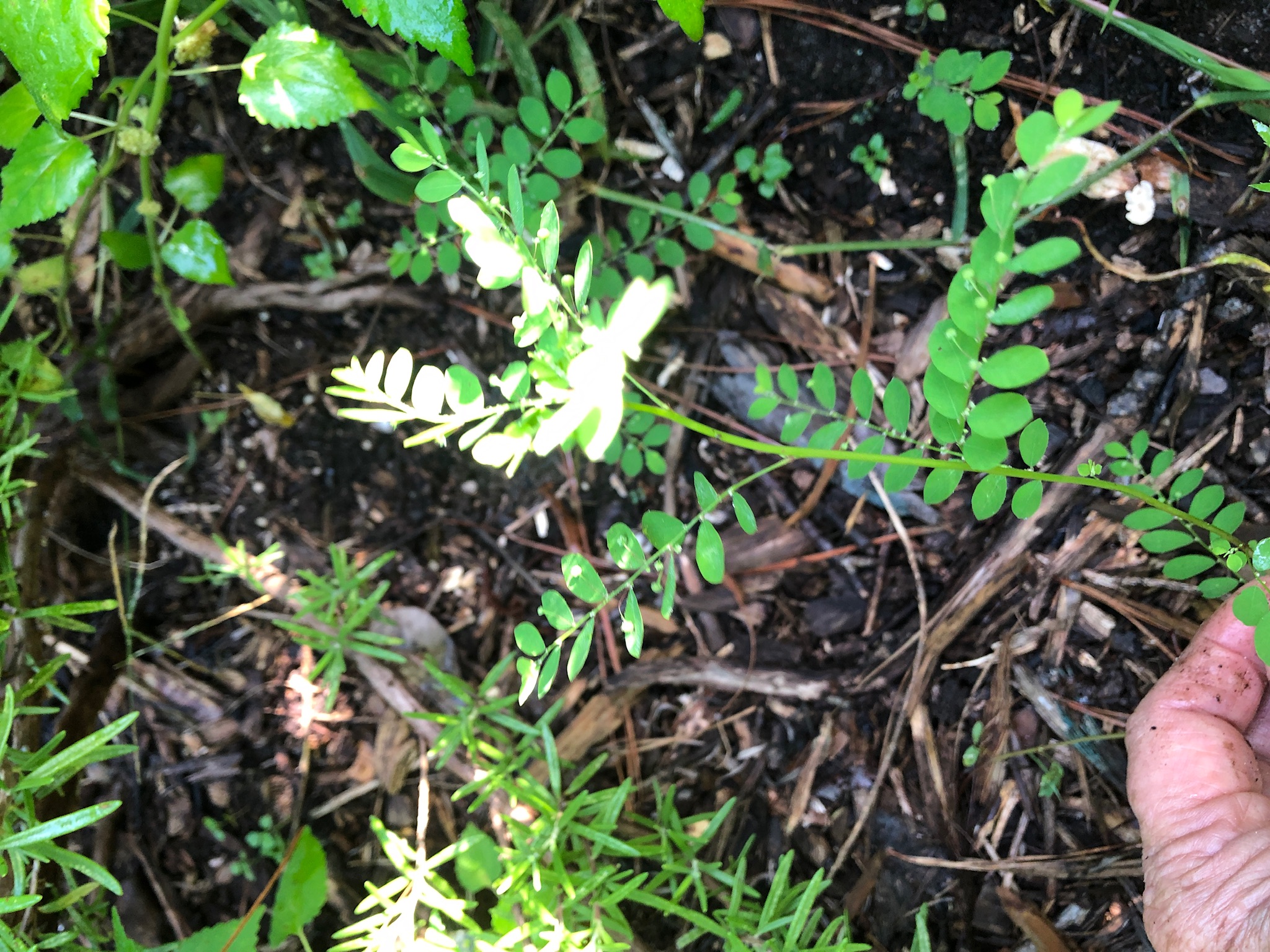
Purple-eyed Grass

The plants in the new VegHeadz rain garden have begun to awaken from their winter sleep. The spring rains and warmth will encourage them to anchor the soil and fill up the space. All are natives and all suitable for your rain garden or landscape.  A few of these have been rescued while clearing the woodsy space behind the grape arbor and rain garden.  

Below is a list of those we have planted so far,

Blazing Star or Gayfeather (Liatris spp.) https://gardeningsolutions.ifas.ufl.edu/plants/ornamentals/liatris.html

Blue-eyed grass and Purple-eyed grass (Sisyrinchium angustifolium) https://edis.ifas.ufl.edu/publication/ag401

Virginia Sweetspire or Virginia Willow (Itea virginica) https://ffl.ifas.ufl.edu/butterflies/browse/Details/202

Blue flag Iris (Iris virginica) https://edis.ifas.ufl.edu/publication/FP288

Ebony Spleenwort (Asplenium platyneuron) https://www.wildflower.org/plants/result.php?id_plant=aspl

Lanceleaf coreopsis (Coreopsis lanceolata). https://edis.ifas.ufl.edu/publication/EP058

St. John’s Wort (Hypericum cistifolium ) https://edis.ifas.ufl.edu/publication/FP261

Oxeye Sunflower (Heliopsis helianthoides) https://www.wildflower.org/plants/result.php?id_plant=HEHE5

Rabbiteye Blueberries (Vaccinium virgatun) https://edis.ifas.ufl.edu/publication/MG359

Thursday, December 21, 2023

Winter Solstice


We have reached the winter solstice, the shortest day of the year. In our north Florida region we are moving into what are really our only two months of winter—January and February—so this wouldn’t seem like a time for rejoicing. But during these coldest months, we can look forward to spring because from this day forward, each morning comes earlier and each day is longer .

The winter solstice is important to gardeners because many plants respond to day length by shutting down most of their processes when days are short and temperatures cool (dormancy). Growth begins again for perennials when days lengthen. The response to changes in day length is called photoperiodism and helps plants adapt to changes in season.  Dormancy is ended by either longer day length, rise in temperature, or a combination of the two.  Some examples of elements which may be controlled by day length are flowering, leaf bud dormancy, and the activation of bulbs or tubers.

So welcome the winter solstice and begin looking forward to spring by poring over your seed catalogs, starting seeds indoors in January in preparation for planting in March, and in general, enjoying this downtime, when many weeds and insect pests are also dormant. 

Wednesday, December 20, 2023

VegHeadz at the Annual MG Year End and Awards Gathering


 Produce fresh from the VegHeadz garden

This week many of the VegHeadz attended the annual year-end and award meeting at the Leon County Extension.  On hand were volunteers and presentations for most of the projects that the master gardeners undertake throughout the year. As usual the VegHeadz had an attention-grabbing display and lots of information and giveaways.  

One of the main attractions for the annual meeting is the award of certificates to individuals who have just completed the recent master gardening class. Over the course of the next year, they will provide volunteer hours to complete their training and become full fledged Master Gardeners at the next year end  meeting. We hope that many of them will join us in the VegHeadz garden.


Peggy is manning the sampling area with cookies 
and jellies which include ingredients grown 
in our garden.  


Emma provided information and bags to 
gather seeds and produce for those in 
attendance to take home.  


Nancy and Cathy are admiring the 
Many types of greens we grow and 
a less familiar vegetable, Yacon tubers, 
for folks to try.  


Corsican gourds for use in crafts 

More veggies


Loofah sponges from our gourds.  
They reseed and reappear every year.  


Seeds saved from the garden 
were a popular stop.  Peggy
Is our seed saving champion.  

Cathy showing off 
her pepper jelly.  


Thursday, November 23, 2023

Tomatoes in November


Photo by Peggy McDonald

A tomato plant in the VegHeadz garden is still bearing tomatoes in November. Master Gardener Peggy McDonald has this to say: “I just picked these on Monday, no bugs and still sweet to eat. This is the first time I’ve picked fresh tomatoes from the garden this late. The tomato plant was a volunteer seedling on the Hugelkultur bed that the birds planted so I don’t have a name for it. I should save the seeds to plant next year.”

Another gardener has a yellow cherry tomato in her yard, either Sungold or Farmer Hernan’s Little Yella, which has reseeded for at least five years and bears fruit long after other tomatoes have faded away.  

Small fruit varieties such as cherry and grape tomatoes tend to be easier to grow in our hot humid summer climate.  Tomatoes slow or stop setting fruit when temperatures rise above 90 degrees.  If the plant can make it through the summer until the weather begins to cool again, it will again bloom and set fruit until frost.  

Plants which reseed tend to fare better through the process of natural selection.  Those that germinate and thrive are likely to be better adapted to their environment and tend to grow and survive better.  So let some of your tomatoes go to seed or drop damaged ones in likely places to reseed naturally. Remember that as a result cross pollination, you will most likely not get the exact same tomatoes if other varieties had been planted nearby.


The volunteer tomato plant.  The red circle is a bat sleeping in the 
plant, which was mentioned in a previous post. Photo by
Peggy McDonald.  


Thursday, July 13, 2023

Beat the Heat

Don’t think it can’t happen to you.  One of our experienced VegHeadz Master Gardeners had a touch of heat stroke this week.  Showing up to get some extra hours in, this gardener was working alone when overcome with the fierce heat we are experiencing.  Fortunately another gardener showed up and rescue ensued.  

Garden early and don’t garden alone.  Wear a hat.  Drink plenty of fluids even if you’re not thirsty.  Rest in the shade frequently. Don’t work until you feel overcome.  It will get cooler   There’s probably nothing that has to get done thus week anyway   

Take care of yourself out there!

Sunday, August 1, 2021

Summer Weeds

Several weeks of rain, humidity, and sunshine have not only encouraged our vegetables to grow but have created a weed explosion.  Weeds aren’t our enemies.  They have an ecological purpose, just like all living things.  But they are a nuisance and an aggravation as they insist on growing where we are trying to reshape the natural environment to our own liking.  In order to attain success in our efforts, it’s good to know more about the plants we don’t want, ie weeds.  Pictured here are some of the weeds you’ll see in your garden at this time of year and a few that you might want to consider leaving.  

Doveweed
The worst—Doveweed.   This article from UF/IFAS explains more   https://gardeningsolutions.ifas.ufl.edu/care/weeds-and-invasive-plants/doveweed.html.  Like most annual weeds, the best defense is to dig it up before it goes to seed. Chemical herbicides don’t really eradicate it.

Chamberbitter

Chamberbitter (Phyllanthus urinaria) and its cousin Longstalked Phyllanthus (Phyllanthus tennellus). Chamberbitter forms branches close to the ground and grows in thick mounds, with seeds affixed to the underside of the lateral branches at the leaf axils. Longstalked Phyllanthus is taller, growing on a central leader with sparser branches and the seeds are on little stalks, not affixed directly to the branches.  Chamberbitter is an annual and propagates from seeds which exist on the plant almost from the time it sprouts. Longstalked Phyllanthus is sometimes an annual but in subtropical climates is a perennial.  Again the best remedy is careful pulling of the plants to avoid dislodging seeds, and disposing of them in heavy garbage bags with household garbage. Chamberbitter is sometimes referred to as Stonebreaker because it has been used by herbalists to dissolve kidney stones.  
Long Stalked Phyllanthus


Erect or Hyssop spurge

Spurges—The spurge family is large and includes the Phyllanthus varieties above.  The ones we often see are Spotted spurge which grows in the cracks of sidewalks forms colonies in exposed areas, and the taller erect or Hyssop spurge we see becoming noticeable in our gardens this time of year.  Both are annuals which need to be pulled before they set seeds.  


Pokeweed

Pokeweed or Pokeberry—A large perennial which can take up a lot of space.  Deeply rooted, it is often hard to pull up.  The entire plant is poisonous to cattle and humans but the tender new growth in spring is edible (after boiling) as “Poke Salat” and in fall and winter its shiny black berries provide food for wildlife.  


Spanish needle (Bidens Alba)

Bidens Alba or Spanish Needles—A perennial or reseeding annual, which creates ambivalence in gardeners because its flowers, produced throughout summer and fall until frost, provide food for bees and other pollinators.  Left alone it will colonize large areas so if you choose to leave some for the bees, control it carefully.  

Monday, February 15, 2021

iGrow Garden is Thriving

iGrow Garden on Dent Street
In Frenchtown

Elder Charlotte Ivy who with her husband Elder Archie Ivy, operates the “Sowing Seeds—Sewing Comfort ministry, tends gardens in a number of places around town.  I spent some time this morning at one of them on Dent Street—the iGrow garden started by Nathan Ballantine, the man in Overalls.  Volunteers were mowing, weeding, and planting seeds for spring crops.  I joined a group from St. Paul’s UMC under the auspices of Tallahassee Green Faith Alliance to sow seeds in cells for growing tomato seedlings.  It was a cool, foggy morning and it was a pleasure to join others to work on growing food for those who need it.  

Plenty of winter crops are still
producing

Many hands make light work of sowing seeds

The cabbages are looking mighty fine


Friday, October 30, 2020

Larry Lesko, 10-5-48 — 6-12-20, Master Gardener, VegHead


Larry Lesko was a valuable and beloved member of our VegHeadz gardening team.  He was there at the beginning when we started developing the garden and he continued to join us when he could throughout his prolonged but losing fight with Leukemia.  This week, thanks to fellow gardener Carole Hayes, we honored him by planting a native Redbud tree in our forest garden along with a commemorative plaque.  Joining us were his wife Teri Cleeland and her sister.  Larry’s last gift to the garden was some of his ashes placed below the tree roots to nourish its growth.  God speed Larry.  We will miss you but remember you always.  For more about Larry, his accomplishments and his his thoughts on life after death visit our Facebook page (@VegHeadz-Community) and Larry’s obituary at https://www.legacy.com/obituaries/tallahassee/obituary.aspx?n=lawrence-michael-lesko&pid=196366749&fhid=5827  and memorial page at https://www.forevermissed.com/larrylesko/about


Larry Lesko and Carole Hayes

Extension Agent Trevor Hylton, Rachel Baker, Janis Piotrowski, Extension Agent Les Harrison,
Larry Lesko, Marcie Praetorius, Carole Hayes

Peggy McDonald, Mike Dugger, Larry Lesko, Cathy Alfano, Louie Doll
 

Tuesday, August 27, 2019

UF/IFAS One-Stop Site for solving Garden Problems

University of Florida Institute of Food and Agricultural Sciences (UF/IFAS) has launched a new one-stop site for accessing information to diagnose garden and plant problems.  Information can be found there on plant insects and diseases, integrated pest management (IPM), soil and water, weeds, and more.  If you can't diagnose your problem, resources are available to help you locate someone who can.  Put this site on your desktop or home screen.  You'll be using it a lot.  https://diagnostics.ifas.ufl.edu

Friday, July 21, 2017

July in the VegHeadz Garden

Perennial Edibles 1 -- Lemongrass, turmeric, culinary ginger,
roselle, sochan, Tahitian taro, Poke weed, arrowroot,
sugar cane

Perennial Edibles 2 -- Okinawa Spinach, Longevity Spinach,
Goji Berry, Naranjilla, Slippery Cabbage, Yacon,
Nopale, Cardamum,
As is typical for this time of year, some of our garden has played out.  The tomatoes are gone, as well as the squash and corn.  But the peppers, beans, herbs, and eggplants are hanging in there with almost daily rains.  The perennial edibles are also thriving.  We have had much fewer bug problems this year than in previous years.

Cover crops are being planted in spent areas.  This year we are using Sun Hemp, inoculated Pink Eye Peas, and Buckwheat to add organic matter and minerals to our soil.  Samples for soil tests in the various areas will be gathered next week.   

We're looking forward to planning an interesting and fun garden for the fall season.

Come visit us in the garden.  We are there almost every Wednesday morning. 

Sun Hemp cover crop in Bed A

Anise Hyssop was buzzing with
bees and wasps


Horticultural Assistant
Kelly Thomas trims an over-rambunctious
chayote vine that was shading the
kiwis

Loofah squash growing on
the arbor

The loofah has such interesting
leaves

Friday, June 16, 2017

VegHeadz Garden update


Veggies harvested last week
We wanted to show off our haul of veggies from the VegHeadz garden for the past couple of weeks.  All were delivered to the Homeless Shelter where Food Services Director, Bill Schack, says they use them in salads, soups, stir fries, and veggie lasagna.  We've donated over 120 lbs. of vegetables this year to help furnish healthy food for those in need. 

The bugs have been kind to us throughout this season.  We've seen some worms in cucumbers and squash, but very few stinkbugs, corn worms, squash borers, and the other usual suspects.  We're keeping our fingers crossed.  I'm sure Laurie's good supply of perennials which attract pollinators and predator bugs are playing a large part.

We've had plenty of tomatoes and peppers on our plants, so pollination isn't a factor, but few fruit on squash and cucumbers.  Just another garden mystery. 


This week's crop

Green Filet beans.  We've had a good crop this year


Sunday, October 23, 2016

Growing Vegetables in the Shade

If you missed the recent article in the Tallahassee Democrat about growing vegetables in the Shade, it's available on the right side bar of this blog under the heading Guest Articles in the Tallahassee Democrat.  Another recent one is an article about the varieties of broccoli which grow better in our area. 

Monday, March 7, 2016

Does Gardening Make Us Happy?

 The VegHeadz  are a happy crew.   Some recent scientific studies have shed a light on one of the reasons.   There are microbes in the soil which are absorbed by gardeners that mimic the effect of antidepressants. I know I'm happier when I'm gardening and we do a lot of laughing. Follow the link below to find out more. And come join us in the garden!

Gardening Makes Us Happy

Monday, February 15, 2016

Free Seeds

Free vegetable seeds are now available at all branches of the Leon County Library.  Anyone with a library card can obtain three packets of seeds.  There are 10 options to choose from.  Better go today. They disappear fast.

Spring is in the air

If we didn't  know better, we would think it is time to start planting spring vegetables. But we know from experience there may be at least one more freeze coming before spring. In the meantime several VegHeadz have been starting (or attempting to start)  seedlings  for use in the demo garden and for their own use. Advantages of starting your own seedlings include obtaining access to a much wider variety of plants and saving the cost of buying commercial seedlings.

Growing your own seedlings can be tricky and requires  an initial moderate investment for grow lights or cold frames and daily attention to your developing plants. The satisfaction of trying some new varieties should be worth it.


Wednesday, January 13, 2016

Adopt-A-Garden

It's exciting to learn of all the vegetable gardens around the city at churches, in schools, in parks, and other places.  There are also lots of groups who are thinking about starting a garden.  The Leon County Extension Office is sponsoring a program headed up by Extension Agent Molly Jameson which will provide a hand up to these programs.

Called Adopt-A-Garden, we are looking for volunteers to mentor one or more of these groups.  Volunteers can choose which gardens they are interested in.   Would you rather work with children?  Do you already have a connection with one of them, or live in their area, etc. 

Mentoring might involve just helping to find answers to gardening questions, or pitching in on garden work days, or helping to select seeds and plants which will grow well in the area selected, or teaching gardening skills, or giving or arranging presentation to the group--the type of help and the amount of time involved is  up to the volunteer and the gardening group they have selected.

No need to be a Master Gardener, although Master Gardeners are certainly encouraged to share their knowledge, but anyone with some gardening knowledge or experience, or teaching skills, or just a willingness to learn and find answers along with the group can participate.  All are welcome. 

Check out the Adopt-A-Garden website to find out more, including the list of gardens which have requested help.  We hope you'll consider adopting one of the gardens on the list. 

Saturday, December 12, 2015

Perennial Vegetables Available Locally


Chaya

We hear Tallahassee Nurseries is now carrying a few perennial vegetables including Chaya and a perennial spinach.  If you shop there, please let them know it's appreciated and perhaps suggest some others for them to offer.

Sunday, March 22, 2015

Gardening Professors

We're always looking for sources of good scientific information about gardening.  Unsupported claims about quick fixes for plant nutrition, pest control and other gardening issues don't carry much weight with us. 

A recent suggestion by a fellow Master Gardener led us to the Gardening Professors blog.  Created by four university professors, the blog has information with a sound basis in scientific research  for home gardeners.
Another source of information from Land Grant extensions (like ours) from all over the Us is Extension.org.

A recent post on cover crops is the first in a four part series on cover crops, and starts with detailing the advantages of cover crops.  We've added this site to our list of places to look for dependable gardening information. 

Sunday, February 15, 2015

Garden News

Marie, Cathie, and Louie

Despite the winter weather, things have been happening in the VegHeadz Garden.  Last week we harvested a beautiful cabbage and a number of other winter vegetables when we visited the garden after our Spring planning meeting.  This week, with the help of two new student Master Gardeners, we dug the asparagus roots, removed a fence trellis from the new work area to a row with snap peas, moved the work table, added bracing to the arbor, and did a lot of weeding.  We gathered soil for a soil test to compare the rows we amended with peat moss and sulfur with the rest of the rows to see if the amendments were effective in lowering the pH.  We'll report more on this when we receive the results.  Thank you Glenn, Mike and Janine for your great help in the garden on Friday, and thanks to all our regular VegHeadz for your enthusiasm, creativity, and perseverance.  The garden is looking great!