Showing posts with label Permaculture. Show all posts

Monday, December 16, 2024

Learning About Biochar

We’ve been given a gift at the VegHeadz garden, and we don’t quite know what to do with it. This year Leon County became the first county in the nation to convert yard debris into biochar, a carbon-negative material, in an effort to reduce carbon emissions. See our previous post and look for “Biochar Overview “ in the left side bar for more information about what it is, why it is beneficial, and how it is produced. 

We have a big bag of the biochar and we need to learn how to use it. It is confusing since most gardeners are just becoming aware of this soil amendment and there is much conflicting and complicated information available from gardening sites, producers, and research reports. Research about use in small gardens is still sparse, with little consensus, standards, or repeatability across the biochar spectrum.
 
Our goal at the VegHeadz garden is to run our own informal trial to determine the best way to use biochar in a vegetable garden and to learn what results it produces and  potential benefits it provides.  We plan to share that information with you in the event you want to use biochar in your garden.


Friday, September 27, 2024

Lulling Your Garden Beds to Sleep

Cathy, Evelyn and Mary prepping
beds for fall/winter crops
We love William Horvath’s information about permaculture and growing food.  His website, Permaculture Apprentice, can be accessed from the Permaculture Resources list on the right sidebar.  You can sign up on his site to receive his periodic emails   They always furnish tons of great information to inspire your gardening.  If you’re interested in learning more about permaculture, he offers excellent online courses.   

His latest offering is detailed information about improving your garden soil during fallow periods.  While it refers to gardens in cooler climates with no winter crop, this method can be used any time your garden beds are not in use for even short periods, or if some of your garden space is unused for a season, or any time you want to rejuvenate or boost your garden fertility.  It’s also good for annual ornamental beds in the off season.  

This method is a good idea to prepare for each new growing season, and doing it several weeks or months ahead gives soil organisms time to multiply and begin their work   

We share William’s information on putting your garden to sleep here:

“Imagine a lush and mature forest in the fall.

Tall trees tower above, while diverse plants carpet the ground, and mushrooms sprout among them. As autumn progresses, trees shed their leaves, blanketing the forest floor, which is already full of plant debris. This rich organic matter layer made of dead plants and fallen leaves then creates a natural mulch atop the soil. Over the coming months, microorganisms slowly break down this mulch, recycling nutrients and delivering them to plant roots in spring.

This is the process that creates that black, earth-smelling soil that's buzzing with life and full of nutrients!

I want to help you mimic this process in your garden and prepare your garden beds for spring.

If you are in the Northern Hemisphere, now is the best time to do this fall/winter soil building and improve the soil fertility of your overworked garden beds.

I call this gardening project Putting Garden Beds to Sleep. So, let’s gently lull them to sleep, shall we?

There are five simple steps to put your garden beds to sleep.

STEP 1: Clean up the garden bed

First, remove all weeds and plant debris from the garden bed. Pick up the dead and rotting vegetable parts and plants to eliminate the possibility of pests and diseases overwintering, and then restart in spring. Pull all weeds from the bed and dig their roots out; this will prevent them from taking over the bed in spring.

STEP 2: Loosen up the soil

Next, loosen up the soil a bit. This will add oxygen to the soil and help improve drainage before winter weather. Use a broad fork or pitchfork to do this. Here’s how this step looks like:

STEP 3: Add soil helpers

Now, inoculate your soil with helpers that will aid in decomposition and nutrient uptake. Unless the soil is already rich in soil life, add worms, mycorrhizal fungi, and beneficial bacteria. You can do this in a number of ways, from compost to compost tea and various inoculates you can make yourself (more on that some other time)

STEP 4: Add organic materials and amendments

Next, add soil amendments and compost to the beds. [Based on the results of a soil test] Depending on the nature of the deficiencies of your soil, you could use:

  • Sulfur to lower the pH
  • Lime to raise the pH
  • Bonemeal or Phosphate Rock to increase phosphorus levels
  • Alfalfa meal to improve the soil condition and nutrient composition.
  • Kelp to supply a range of trace nutrients, as well as a dose of plant hormones.
  • Wood Ash – to increase potassium levels and raise pH.
  • Composted animal manure – to supply a variety of nutrients.

Once you are done, spread generous amounts of compost, preferably from your compost pile or worm castings. Apply it in a 2 – 4 inch (5 – 10 cm) thick layer. Finally, work in the soil amendments and compost into the top 6 – 8 inches (15 – 20 cm) of the soil with a spade or digging fork.

In my case, I’ve spread my not-fully-yet-decomposed compost, which will break down over the next 4-5 months.

STEP 5. Add organic mulch for protection

Lastly, add a layer of organic matter in the form of mulch. Mulch is like a warm blanket you spread over your garden to keep it safe and protected through the winter.

A good mulch insulates the soil, keeping it from freezing or at least from freezing as deeply as it otherwise would. This allows soil organisms to remain active for much longer. It also prevents weeds from invading the dormant bed during winter, and as an icing on the cake, as it breaks down, it releases new nutrients into the ground.

Leaves and leaf mold, grass clippings, straw, and hay are good choices for winter mulch. Spread the mulch evenly with your hands or rake.

And that’s it. That’s how you lull your garden beds to sleep.

You’ve added all these organic materials, and now it will start breaking down, enriching your soil, and becoming biologically active for your plants in the spring.

Happy growing,

-William”

Monday, July 22, 2024

More Input on Regenerative Gardening

Tridens flavus
Purpletop 
Photo by Mail Order Natives
The VegHeadz received an email this week from Hope Corona, a follower of our blog, who wanted to make a comment on a previous post.  Her comment was too long for the blog app to accept so she contacted us to see if we could post it for her. 

She is referring to our previous post about sustainable and regenerative gardening.  Link to Previous Post  Here is her very interesting comment.  She’d love to have some feedback.  Thank you Hope, for your thoughtful input and for providing information on new things to try!  As our contribution, we have supplied links for more information on her reference plants and refer you (and Hope) to this study of native plants in North Florida landscape conditions. Link

Hope’s Comment:

I'm always delighted to see one of your new blog posts in my email box :) !  Love your posts! 

I wanted to submit a comment to your recent post "Beyond Sustainable Gardening," but my comment was rejected as "too long." Perhaps you can help?

Wow...I've been thinking these same thoughts lately too....and realizing I need to move further towards regenerative urban veganic farming, but I'm encountering some challenges along the way.

IFAS has virtually NO published research or recommendations (at least that I have yet found)  regarding the use of NATIVE plants (grasses, legumes, nitrogen-fixing and nematode resistant species, etc.) that can be utilized for our cover crops and perennial "chop and drop" and pathway plantings in a regenerative tiny lot urban home landscape.

So....it appears to suggest that it's going to be up to all of "the rest of us"  (backyard gardeners and small market farmers)  to work together, doing our own trials and research, collaborating "virtually" to develop a list of potential regenerative native plants, seed sources for same, and the seeding dates that work most successfully for the obvious and most desirable planting windows in Florida's North, Central, and Southern areas.

Anybody else "IN" on this project? Or an easy "virtual" way to collaborate (a place here on your awesome site?)

Here are some of my observations so far from my tiny, urban postage stamp lot in Zone 9, Chassahowitzka, FL (34448):

*Perennial nitrogen-fixing chop and drop
Senna Ligustrina, aka "Florida Native Privit Cassia
Link to more information
Awesome Success!  Disease free, gorgeous glossy-green compound leaves that make beautiful compost and chop & drop when mixed or covered with any "brown" (leaves, pine straw, etc.).  Seeds are easy to come by (look for them when you hike the woods...they're plentiful, readily germinate, and the resulting plants will self-seed forever....you'll never run out of seeds to keep and share).  It attracts beneficials and pollinators; it hosts native butterflies; it gently shades and protects whatever seedlings (that the birds or your compost planted ;) beneath it, such as squash, pumpkin, watermelon, peppers, etc.  It's strong branches don't lodge and can provide trellis for climbing volunteers (cowpeas, etc.).  It dies back in a hard freeze, sometimes comes back from its roots in spring, and definitely reseeds to replace itself.  It's easy to take out if you don't like where volunteers landed too :).   If Senna ligustrina isn't the native Senna in your own Florida neighborhood....look for the Senna that IS :).

Nitrogen fixing lower shrub / herbaceous annual plant position (flower bed front or mid border height): 
Chamaecrista (fasciculata, nictitans, etc. - the ones in your area): Partridge Pea
Perfect for that position, but tricky to get the timing right on seeds for the "it's getting hot" window.   I haven't found the best seed scattering time yet.  They're "hard seed," meant to have uneven germination, and they do seem to prefer some cold stratification here in Zone 9, but when there are lucky "volunteers," they are just perfect.  It's really hit or miss for me, especially as the spring turns to summer.

Pollinator attracting, Nematode suppressing flowering plant:
Gaillardia (o.k....I know...not really a "native," but it seems Florida-friendly enough here).  
It's another marigold-like nematode suppressive plant that is (according to published research online) a marigold alternative where and when tagetes may not be an optimal choice (such as where pests - slugs, spider mites -or pathogens (foliar pathogens), or soil conditions keep killing your marigolds).   Gaillardia chop and drop readily decomposes too when you just can't handle their sprawl into your paths towards the end of their season :).  Gaillardia seems less demanding of perfect soil conditions, and often provides welcome "color," and cut flowers for your garden at the times when few other flowers are blooming.

*Grass
this is the most difficult for me: please post your finds!
So far:
Native  Purpletop - Tridens flavus
Link to more information
seems most promising here (Zone 9), but I can't quite figure out the right seeding time.  However, the existing plants we have provide excellent chop and drop, accept high-mowing when necessary (for neighbor-friendly front yard), come back with resilience when used as a perennial landscape element, and are easy to remove entirely where you don't want them anymore.   They're a nice height for urban residential planting (knee-height), and their seed panicles are gorgeous purple-y decorative elements in your fall to winter landscape.  Seeds are readily available online, affordable, and purchase of new seed becomes unnecessary if you maintain a perennial patch for your own seed-saving.  It seems more tolerant of semi-shade, and the dramatic sun to shade conditions that can happen in urban landscapes where "urban" features of the tiny lot (your neighbor's trees and fences, the daily and seasonal shading caused by your own house, your neighbor's homes, etc.).  It seems to tolerate urban alkaline-ish soils (like that over your existing or former septic field) much better than some of the acid-soil demanding native grasses.

Woodland oats (Chasmanthium) volunteer here....but I haven't gotten enough seed yet to trial.
Everything in your landscape is a candidate for chop & drop or compost - even your roses - thorns and all! :)  (I used chop and drop rose parts in a worm bin one year and the worms LOVED them; rose parts readily broke down in my vertical worm tubes and in-ground hole-y compost buckets too :).    Ditto with peach and plum tree clippings, etc.

Lots more to share...but this "comment" is already much too long.

I know you guys already know most if not all of the above...but perhaps my comment inspires or incites :) some of you to post your own better suggestions :).    

I'm ALL ears!

Looking forward to the day when we can all surf online and find affordable bulk quantity seeds for Florida Native Cover Cover Crops and path grasses (like the OTHER states already have with their "eco-grass" selections).   

Why are our Florida University extensions so behind the ball on this?  
(Doesn't suit their corporate donors' best interests? So no funding for regenerative / native / affordable?  Therefore no interest?  Come on PhD candidates out there....find the right prof and pitch it!)

Hope I haven't offended anyone or poked the bear too badly.

I'm old, and on the spectrum...so please forgive me.

Wishing you all health and happiness!

Hope (E. Hope Corona)

Gardening on an impossibly tiny postage stamp urban lot in Chassahowitzka, FL (Zone 9, on a canal to the Chassahowitzka River & Gulf....the front lines of sea level rise and climate change 🙄)

Saturday, June 22, 2024

Beyond Sustainable Gardening


Our gardening practices at the VegHeadz garden have changed as our awareness of our environmental impacts has increased. There are two overlapping types of gardening for those who want their gardens to be environmentally friendly which are similar, but distinct—sustainable gardening and regenerative gardening. Sustainable gardening aims to do no harm and maintain current conditions. Regenerative gardening goes a step further and seeks to actively improve and restore ecological health, making the garden a positive and integral part of the surrounding environment.

Sustainable gardening focuses on creating and maintaining a garden that meets present needs without compromising the ability of future generations to meet their own. Practices promoting garden sustainability include:

Resource Efficiency: Using water wisely, selecting drought-resistant plants, and employing rainwater harvesting systems.

Soil Health: Maintaining soil fertility through composting, mulching, and minimal use of synthetic fertilizers.

Biodiversity: Planting a variety of species to promote a balanced ecosystem and attract beneficial insects.

Waste Reduction: Recycling garden waste and avoiding single-use plastics.

By implementing these practices, sustainable gardening aims to minimize environmental impact, conserve resources and promote long-term ecological balance.

Regenerative gardening uses these and other methods to not only maintain, but to improve the health of the garden and surrounding ecosystem. Its goal is to heal and rejuvenate the landscape of which the garden is a part, resulting in a net positive impact on the environment. Regenerative agriculture/gardening refers to methods that result in improved soil health, carbon capture, improved biodiversity and healthy water resources.

Soil Regeneration: Building soil health through practices like no-till gardening, cover crops, and the use of biochar to increase carbon storage.

Ecosystem Restoration: Creating habitats in and around the garden area that support wildlife and nurture native plants, restoring any degraded landscape and increasing biodiversity in the area by practices such as reducing turf and replacing with native shrubs and ground covers, controlling erosion and runoff to improve area water quality, and creating conditions favorable to microorganisms. When possible, this includes “wilding” areas to allow nature to restore the habitat with no input other rhan removing invasives.

Regenerative Design: Designing gardens to mimic natural ecosystems, integrating permaculture principles and making the best use of non-renewable resources. An important aspect of regenerative design is creation of a closed system where waste from one element is used as a resource for other elements in the design.      

Carbon Sequestration: Actively working to capture and store atmospheric carbon in the soil and in the plants.

Regenerative gardening includes disturbing the soil as little as possible, keeping the soil covered, providing a continuing supply of organic matter, keeping living roots in the soil, planting more perennials, and placing an emphasis on diversity by planting many different species and varieties, including natives when appropriate, which are more likely to thrive in that particular environment.

Desired outcomes of regenerative gardening include improving soil health (structure, organic matter, and fertility), increasing biodiversity, increasing soil carbon retention, conserving water and improving water quality, maintaining or improving garden productivity without application of synthetic chemicals, and reducing greenhouse gas emissions.

Sustainable gardening is a vital first step in reducing our ecological footprint, while regenerative gardening offers a path toward healing and rejuvenating Earth’s natural systems. 

Both sustainable and regenerative gardening practices are essential for creating a healthier planet and lessening our environmental impact by producing some of our own food and reducing waste generally. A positive byproduct is improved diet, healthier food products, and beneficial exercise. After all, we are also part of the environment.  

This brings to mind the proverbial “butterfly effect” which merely illustrates that small things matter, and we are all connected to a bigger system. Our actions now, today, are the result of previous actions and this can, in turn, lead to a different future. With one small gesture we can change someone's life or help change the world. 

By incorporating elements of both sustainable and regenerative gardening, we, as gardeners, can contribute to a more resilient and thriving environment in our own space and the world in general, recognizing that everything is connected.

Good Source of more information:  SARE— What is Sustainable Agriculture? https://www.sare.org/resources/what-is-sustainable-agriculture/

Saturday, January 20, 2024

Permaculture Principles


Many permaculture elements were included in the design of the VegHeadz Demonstration Garden and continue to be used in growing and maintaining it.   To name a few:  

  • The berms and swales we created to capture and control the flow of water on our sloped site and the recently constructed rain garden for further water control.  
  • Utilization of crop rotation,  cover crops and no-till methods to minimize pests and diseases and build the soil.  
  • Minimal use of chemicals, pesticides, and commercial fertilizers. 
  • Production of compost and extensive use of sustainable and recycled mulches.
  • Use of the garden to teach others and contribution of our excess to those who have less.
  • Utilization of Hugelkultur and food forest growing techniques.
  • Planting many different species and varieties throughout the garden to provide biodiversity and mutual benefits.     
There are more.  If you’re not familiar with permaculture, read the article under Permaculture Resources in the right sidebar— Permaculture—What Is It?

A new addition to our permaculture resources is a concise statement by permaculture designer Brett Prichard of Mollison’s fundamentals in permaculture ethics and design which are definitely worth a read.  In particular, permaculture ethics set out a map we should all follow in living our lives in a way to preserve the earth for future generations.  

https://www.permaculturefundamentals.com/?p=36


Saturday, November 11, 2023

Hugelkultur

Hugelkultur bed at
 VegHeadz garden
If you follow this Blog, you’ve heard us talk frequently about our hugelkultur bed. This is a German word meaning mound culture.  It stems from early European gardening practices and was adopted and adapted by the permaculture community because of its many gardening and environmental advantages   

The benefits of hugelkultur can be achieved by growing in mounds built over logs and other organic material, or in traditional looking garden beds by making them deeper and adding logs, branches, and other organic matter before filling the bed with garden soil.

In addition to the hugelkultur bed in the VegHeadz garden, when the raised beds were built, we filled the bottoms with oak logs, banana trees, leaves, and whatever other organic matter was at hand. We then filled the beds with garden soil mix and compost. As the organic matter at the bottom has decomposed, the level of the beds slowly lowers and we’ve added compost and garden mix at the top. 

A variety of rough organic
materials were added to our
raised beds before garden soil.  

What are the advantages of hugelkultur gardening?

  • Carbon sequestration.  Carbon from the organic matter in the bottom of the bed is sequestered in the soil as the material decomposes. Whatever we can do to capture carbon is a benefit to the environment.
  • Less waste. Instead of tossing yard waste, like fallen branches and leaves, these materials are repurposed to provide benefits on site. 
  • Less watering. As the organic materials at the base of the bed decompose, they hold water like a sponge, helping to keep garden soil consistently moist and reducing watering requirements.  
  • Less fertilizer. As the natural materials in the bed break down, they release nutrients into the soil, creating compost in situ.  Decomposed wood creates some of the best, most pH balanced compost.  It’s been nourishing forests since the beginning of time.  
  • Kind to backs.  Hugelkultur beds are built above the ground as high as you’d like,  so you won’t need to bend over as far to tend them.
  • Season extension.  As the base organic material decomposes, it generates some heat. Thus soil warms up slightly sooner in spring and a few degrees are added to the garden microclimates as frosts approach.
  • Good for heavy feeding plants. Pumpkins and other squashes are voluminous plants and heavy feeders.  In a hugelkultur bed they will have all the nutrients they need and more room to grow as they cascade down the sides of the mound. 
  • Good growing option for poor soils.  It’s hard to grow in sand or heavy clay soils, but hugelkultur beds are built on top of existing soil, allowing you to grow a garden even if you have very poor soil.
  • They’re also good for small spaces because you can grow on the top and the sides of the bed providing room for more plants in less space.  
  • In raised beds, they reduce the amount of soil needed to fill the bed.  Only the top six to eight inches need to be garden soil.  Much less expensive if you are buying garden mix or compost to fill your beds.  
  • No tilling needed and less weeding.  The seed bank (latent weed seeds in the native soil) is not activated.  
The main disadvantage to this type of garden bed is that it takes some organization and a good deal of effort to construct it. If you do not have suitable materials on site, locating materials is another hurdle.

See this earlier post for more information and resources on Hugelkultur and detailed instructions on how to build a bed.  https://northfloridavegheadz.blogspot.com/2014/02/hugelkultur-another-way-to-garden.html
Hugelkultur bed in garden of Regine Malign-Lynch in Betton Hills, Tallahassee

Hugelkultur bed on property of
Anna Lee in southeast Leon County, Florida


The VegHeadz hugelkultur bed 
created by MG Peter Goren
has many layers

Digging the trench for base layer 

Layers of logs, branches, leaves,
and wood chips 

Final layer of garden soil and then mulch 

Hugelkultur bed planted with cowpeas and Seminole pumpkins.  
Trellises to support Giant sunflowers now provide space for
the cowpeas to climb.  


Saturday, April 8, 2023

How to Start a Food Forest

We get a lot of interest in our small food forest at the VegHeadz Garden. Visitors often ask how we started it, how we decided what to plant there, how much maintenance it takes, etc. 

If you’re thinking about starting a food forest, planning is the first important step.

William Horvath is a geologist and permaculture practitioner who lives in Croatia. He has a very informative website about Permaculture, The Permaculture Apprentice,  and conducts online classes on a variety of related subjects. In a recent blog post he provided detailed steps for starting a food forest.

“Would you rather have a food forest where you need to continuously put extra effort into your plants only to find that they eventually die and need to be replaced?

Or…

“Would you rather have a food forest that thrives almost on its own, requiring little maintenance and input? A food forest that will be the legacy you pass on to future generations.”

A most intriguing question. Obviously most of us would choose the second option. To view William’s step by step plan for starting such a food forest in your location, go to his website which you can access here: William Horvath— How to start a food forest, step by step.

And come visit the VegHeadz garden, take a tour of our food forest, and ask questions on any Wednesday morning.


Wednesday, February 15, 2023

Berms and Swales

Digging the original swales at the
 VegHeadz garden in 2018

Preparation for the planting of a small blueberry patch is under way at the VegHeadz garden. In preparing a site to plant the blueberry bushes, the question of berms and swales came up. One of the Florida Friendly practices recommended by UF/IFAS is to use rain gardens, swales, and berms to catch and filter stormwater runoff.   When the garden was redesigned about five years ago, a series of berms and swales were created perpendicular to the slope of the garden to mitigate erosion occurring during heavy rains. There are a number of reasons to dig swales, which are just shallow ditches, and to back them with berms, which are just earthworks that are created from the soil removed from the swale area.The first reason, of course, is to control the flow of water on the surface of an area. A swale is cheap and easy, requiring only a shovel and your labor. The swale is dug along the contour line of the land so that the water is distributed evenly throughout the length of the swale and is not allowed to erode or accumulate at one spot. This slows the water down and allows it to percolate into the soil along the length of the swale for storage. Planting trees and shrubs along the swale is important to this process, because the trees help to absorb the water that is being stored, and the roots stabilize the berm and the area around the swale.Additional benefits of a berm and swale system are to treat water quality using soil, vegetation and microbes; reducing the total volume of stormwater runoff; increasing infiltration and groundwater recharge; and they can be a an attractive part of the landscape and improve biodiversity. This is a simple and low tech method to irrigate an area. As the water is absorbed into the soil, it is stored there until it is used by area vegetation. This also captures nutrients and organic matter that flow down the slope, and keeps these materials from flowing into area water bodies to increase algae blooms and create pollution.  The berm is a convenient place to put the dirt that is removed from the swale, it allows the swale to hold more water in the event of a heavy downpour, and it provides a place to plant things that needed a more arid growing environment. Over a period of time organic matter accumulates in the swale, and it may need to be dug again, either completely or partially. This is what brought up the subject in the VegHeadz garden. Once the blueberries are planted, it would not be a good idea to re-dig the swale, because blueberry roots could be damaged in doing so.  We are digging and cleaning out the swale now, before planting the blueberries. The soil that is dug from the swale is rich and full of nutrients which have accumulated there as water has percolated into the soil, and from organic matter that has decomposed there.  It can be added to the existing berm or deposited in other areas of the garden.The contour of the property is easily determined with the use of a simple A-frame level which can be built of long straight sticks, scrap lumber, bamboo, or purchased 1x2s.

All that is needed are two long pieces of wood or bamboo approximately the same length, and a third shorter piece.  Line up the bottom of the two long pieces, so they are flush and then secure them together at the top with a screw or twine or some other method. Measure the same distance up from the bottom on both legs and place a mark.  Secure the third piece of wood across the two legs at the mark on each leg, creating a crossbar.   

There are two options for finishing the A-frame level. One way is to secure a bubble, spirit, or carpenter’s level to the crossbar. The second is to suspend a weighted string or plumb bob from the top of the “A,” and locate the level center point of the crossbar.  These two methods are explained in detail here and here.

Once you have created your level, you are ready to find the contour of your property.  Place the A-frame upright on the ground where you want your swale and mark the foot of one leg with a flag. We’ll call that the first leg. Rotate the other leg around until the frame reads level either with the bubble in the carpenter’s level or with the weighted string at the center mark on the crossbar, depending on which method you have chosen. Place a flag at this point, the second leg. Keeping the second leg in place by the flag, now rotate the first leg around to find the next level point and mark that. Keep going as far in each direction as you like, marking each point, and connecting them with a smooth curve.   For multiple berms and swales down a slope, measure each location individually as the variations in elevation will differ from one level to the next.   
This is your level contour where you will dig your swale. Dig the swale the depth and width that you prefer, keeping the bottom of the swale as level as possible. The swale should be closed at each end unless it is being used to direct water to another area. The final step is to run water into the swale to make sure it flows evenly along the entire length of the swale and to make any adjustments necessary if it does not.   


Photo from Santa Cruz Permaculture.com

Wednesday, December 14, 2022

Wednesday in the Garden

Pigeon peas (Cajanus Cajun) have been grown in tropical and sub-tropical regions for thousands of years.   They are a perennial legume related to chickpeas, alfalfa and peanuts. The largest producer is India where they are used as the split pea known as dhal. In the Caribbean, they are a common side offered at restaurants. They can be grown as an annual or as a short-lived perennial, living up to five years.  

We’ve been trying to grow pigeon peas in our food forest at the VegHeadz garden. The first attempt last year was a total failure. This year the peas have flourished, but they have not yet formed pods.  It is said they should be harvested after the first frost, but they better get busy if they are going to make pods in time this year.

We’ve mulched the roots heavily in an attempt to help them make it through the winter in our north Florida area.   More information can be found here: https://plants.usda.gov/DocumentLibrary/plantguide/pdf/pg_caca27.pdf
Pigeon peas

The plants are about 8 feet tall but have remained erect for the most part. Strangely we have a plant which blooms white which is not mentioned in the literature about pigeon peas. All the other plants have yellow blooms which is typical. It’ll be interesting to see if their Pods are any different also. 
Atypical white blooms on 
Pigeon peas

Many varieties of fall greens and salad vegetables were harvested today, and preparation for constructing the new grape arbor proceeds apace, but the major effort today was mulching with the the very nice finely chopped mulch delivered last week. It appears to be from tree trimming as there are green leaves mixed in with the wood chips. The green leaves and wood chips will start composting a little faster than just plain dry wood chips, and the composting process will provide a few degrees of warmth wherever the mulch is placed which should help our plants weather cold snaps nicely.

Mary Janik


Carole Hayes and Peggy McDonald


Carole is getting the job done


While they can’t all be distinguished clearly, pictured here in one corner of the edible forest garden are kumquats, elderberry,  mayhaw, goji, peach, pigeon peas, coneflowers, pokeweed, and lemon grass

The food forest is gaining maturity with plants filling out to increase their spread and shade out weeds. We’re still adding new things, and this fall we have multiple types of cover crops in bare spots to build soil and discourage weeds.  

Friday, May 6, 2022

Perennial plants for your Food Forest


Thinking about starting a Food Forest or interested in adding plants to one you’ve already started? Plants for a Future (https://pfaf.org/user/Default.aspx ) is a great place to start looking. 

An additional resource that has a lot of useful information is the blog by William Horvath, a Permaculture gardener in Croatia. His blog posts on Permaculture Apprentice (https://permacultureapprentice.com/ ) have practical up-to-date information for people who are just starting out and doing it on their own. He’s done it and he’s passing the information on. It’s a great place to get information.   Subscribe to his blog and use his Food Forest Plant selection Spreadsheet Template to help select your plants.    


Tuesday, March 1, 2022

Permaculture


Hugelkultur Bed
We use many so-called Permaculture techniques in the VegHeadz Garden such as the Hugelkultur bed created by Peter last year, and the swales and berms we constructed to control water on the garden contours when the forest garden was established. We are in the process of combining our companion blog North Florida Permaculture with this blog because they are so inter-related. Let’s start with what is Permaculture? In the coming months we’ll be including information and techniques that will help you not only to grow your own food, but to create an environment on your property that will help sustain your family in good times and bad.


Digging swales to control runoff
And conserve moisture for plants


Thursday, June 3, 2021

Wednesday in the VegHeadz Garden


Laurie and Peggy learn as Kwan builds
a bamboo tomato trellis
So many neat things are going on in the garden this week. Peter has completed the Hugelkultur bed and planted a buckwheat cover crop to grow the population of soil microbes and prevent leaching and erosion during the hot, rainy summer months until a fall crop can be planted.  Keep an eye out for Peter’s report on the the history of Hugelkultur and it’s advantages in the garden.  

The bamboo is pegged onto the completed
Hugelkultur bed to keep the garden
soil mix from eroding
until plants grow to secure it. 

Kwan built a trellis from bamboo he harvested in the garden for the indeterminate tomatoes in the 4-H bed.  He uses a plastic clip to secure the vines to the cords he hangs from the trellis. 

Plans are under way for new container gardens in the fall, spring/summer crops are still thriving and early spring crops like peas and potatoes are being replaced with okra, sweet potatoes, and field peas.  

Next week we’ll be doing some more work with bamboo as we build a trellis for a passionflower vine that has volunteered in the garden.  The butterflies will love it, and it will be a good way to learn a new skill as many of us have not worked with bamboo.  

Kwan demonstrates the clips
He uses to secure tomato vines.  
He uses twine from pine straw bales. 


Tuesday, August 27, 2019

Bananas

Did you know a banana is a berry?
This has been a good year for bananas.  Last winter was a warm one and our bananas did not die back as they do in a "normal" year.

Bananas usually take two years to produce fruit in our area and they are not freeze-tolerant, so a mild winter is necessary for fruiting.  They will usually survive down to 28 degrees.  Frozen plants should be cut back to good growth in the spring.  Even if they freeze to the ground, they will usually return from the underground rhizomes.

Once a stalk bears, it should be cut to the ground as it will not bear again.  It is recommended that clumps consist of three plants, a large bearing-size stalk, a medium stalk, and a small shoot.  

When the banana stalk develops, the bloom at the bottom will descend, and the exposed stalk and bloom  may be cut off to encourage better development of the fruit.   Unfortunately the tree pictured is too tall to reach the stalk.  Perhaps the tree will have to be cut down to harvest the bananas.
 
If the frost threatens before the bananas are ripe, cut the stalk and ripen the bananas inside.  They will ripen inside at any time after the bananas are fully developed.  Bananas like a lot of water and a lot of nutrients.  For all you need to know about growing bananas, the difference between plantains and bananas and much more information see:  https://edis.ifas.ufl.edu/mg040

Even if your bananas are not as sweet as those at the grocery store, they make great banana bread.  The recipe below was developed one year when the banana trees in back of the office where I worked bore 18 stalks of bananas giving a friend and I ample opportunity to test many banana bread recipes.  This was our favorite.

Banana Bread 

 1/2  cup (1 stick) butter           
1  cup sugar
2 eggs
1  Tbsp. vanilla
1  cup mashed bananas (about 3 bananas)
1/2 cup low fat buttermilk (or substitute 1/4 cup milk and 1/4 cup sour cream)
2  cups sifted flour 
1  tsp. baking soda
1  tsp. salt
1  cup nuts, chopped

Cream butter and sugar together.  Beat in eggs, then bananas, milk, and vanilla.  Sift together dry ingredients except nuts.  Add to banana mixture, stirring lightly to mix.  Fold in nuts.  Pour into greased and floured 9 x 5 x 3 inch loaf pan.   The pan should be about three-fourths full.  (Makes one large loaf, two smaller loaves or four mini loaves.) Bake at 350 degrees about 60 minutes, less for smaller loaves, until pick inserted in center comes out clean.

The flour can be white or whole wheat or a combination.  Oat bran or oatmeal pulverized in food processor is also good as part of the flour.  The sugar can be all white or half white and half brown.  (For brown, pack when measuring).  The riper the bananas, the better.  In fact, when bananas get too ripe to eat, store them in the freezer, peel and all.  When ready to use, thaw until just soft, peel and pour into cup to measure.  They look really yucky, but the banana bread they make is moist, sweet and strong in banana flavor.

Wednesday, September 20, 2017

Permaculture Events Coming Up - All are Welcome


Permaculture structure at LuLuLand
There are a number of events coming up for those who want to learn more about permaculture. They all look very interesting and include hands-on activities as well as opportunities to connect with others. All are welcome.

October 1st - Garden Tower Workshop at Bless The Waters - 1311 Tom Still Rd. Tallahassee 32305
This is a great excuse to come visit the developing Bless The Waters Urban Permaculture Site as well as to participate in erecting two Garden Towers. These towers are a terrific design for growing over 50 plants in a small space and using vermiculture to feed them. Bring a seedling to install once the tower is up!

We'll begin by 11 AM and likely run until 3 PM, weather dependent. Bring seedlings, snacks to share, and an open mind !

October 8 - Brains Brawn & Beauty - Women in Permaculture Workshop at LuLuLand - 4560 Charires Cross Rd Tallahassee 32317.
This is a day long workshop focused on women's particular attributes and perspectives on healing ourselves & our planet through permaculture design. Areas of discussion and demonstration will include:
- Breaking the Grass Ceiling
- Remembering women's contributions through history - Communing with Nature
- Loving Self, Loving our Planet
- Beauty and Function in Permaculture Design
- Empowering women to design & build structures we need
- Using tools well - with special guest Bill Oterson (and perhaps another guest)
- Working with your body's needs in mind
- Hands on building project (weather dependent)
- Building our social network
- Moving forward
Women of all ages welcome and needed.

We'll gather at 9 AM, begin the workshop at 10 AM and go into the evening. Sun sets at 7 or so, and a fire can happen then if there is a desire stay longer to enjoy this for a while (weather dependent). .Bring chairs or blankets, food to share in potluck, Work gloves and clothing. Donation of $20 suggested or trade in work time.
BIG EVENT COMING!!!
North Florida Bio-Regional Permaculture Gathering November 3, 4 & 5 at LuLuLand
All ages welcome! We'll work wiuth parents to set up a special play and learn space for children.
Just interested in Permaculture and want to know more? Come with an eager and open mind to learn and participate!

Think you are well versed in permaculture and still want to know more? Come share your experience with others, learn more, and build our community!

This will be a camping out event at beautiful LuLuLand. Of course, you don't have to camp here, but you would miss out on some of the adventure and fun! Water and tea will be available, but food is bring your own & share as a potluck as you choose. Having someone bring prepared food is a possibility if there are enough people who want that and are willing to pay in advance...you'll have to let us know if this is your preference.

There will be an entry fee, but teams will be needed to make this event happen and work time can be scholarshipped in lieu of entry fee. Sign up ahead of time to be assigned to a team as more information details are released. Team members will be encouraged to come on Thursday November 2nd to set up your personal camp and to get instructions and team building play time ahead of the event opening on the 3rd.

This is a fun and fullfilling permaculture opportunity for anyone seeking information about permaculture, how-to coverage of a multitude of subjects, hands on experience, interactive dialogue, inspiration, connection, relaxation, music & FUN!


Saturday, July 19, 2014

Planning for a Fall Garden

VegHeadz Perennial Garden
Now is the time to plan your Fall Garden.  Remove spent plants and weeds in the cool morning hours.  Plant cover crops -- field peas, buckwheat, etc.  Just cast out the seeds, and lightly rake.  Water to aid in germination and let them grow.  In the alternative, cover your weeded beds with mulch -- pine straw, oat straw, oak leaves, wood chips, to retain moisture and discourage new weeds.  Now is the time to start your seedlings if you are so inclined--brassicas such as cabbage, collards, kale.  Despite the heat and humidity, it's a time of promise for a cool productive garden in the months ahead.

And speaking of heat and humidity, the perennial garden in the VegHeadz demo garden at the Extension Office is thriving in the heat and humidity.  Most varieties were planted in April, and all are threatening to outgrow their allotted space.  Cuttings will be available at the Fall Open House on November 1, so plan to be there.   The perennial garden includes summer greens at a time when most greens have long since wilted and gone.  Tasted Friday were Okinawa Spinach, Pacific Spinach/Slippery Cabbage, Sochan/Cherokee Greens, and Arugula.  They were all very tasty and would make a great summer salad.  Other greens in the garden are available to be cooked like spinach.  The yams and sweet potatoes are sprawling among the other plants and their roots will be ready to harvest soon.   No weeds can grow among the thick leaves.  The test will be to see how these more tropical plants survive in the winter cold.  Stay tuned. 

Tuesday, May 13, 2014

Sustainable Gardening in the Desert

Chef's garden in Tucson - Note Saguaro Cactus in left corner
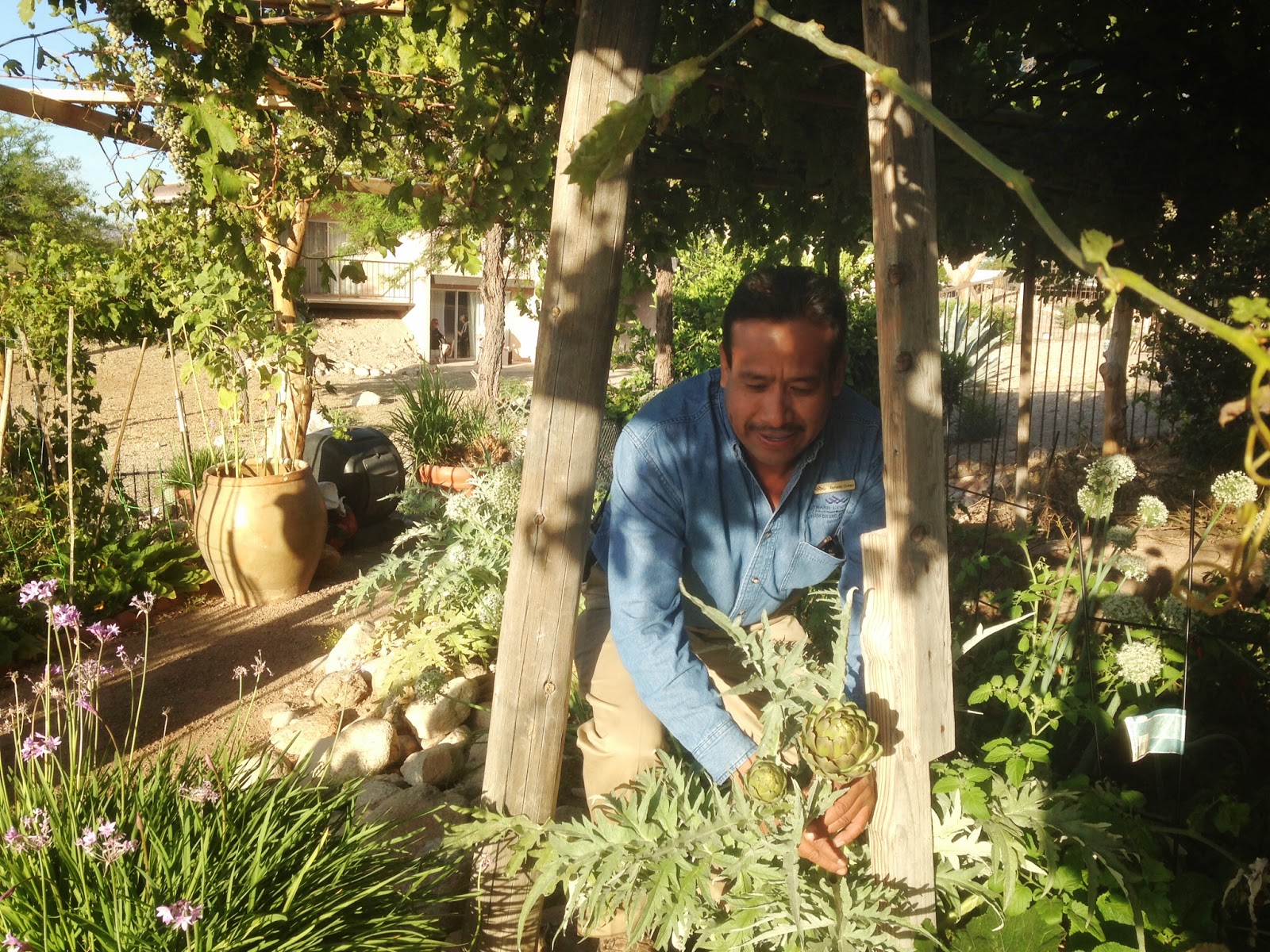
While taking an early morning walk at the Westward Look Wyndham Resort while in Tucson recently, I discovered the Chef's Garden, a beautiful oasis in a desert setting.  While I was exploring the garden and it's many delights, Landscape Manager Raymundo Ocampo made his morning visit to the garden.  I was treated to a personal tour of his pet project, as well as a sweet juicy peach from a tree so laden with peaches the branches were sagging to the ground. 
Landscape Manager Raymundo Ocampo displaying
the Globe Artichokes he grows


The organic garden is situated on a hillside to receive the morning sun and some afternoon shade.  It was designed by Mr. Ocampo with many sustainability features, and is filled with a wide variety of vegetables including many types of heirloom tomatoes.  
Heirloom tomatoes are grown under
shade cloth

 It also features grapes and over 20 fruit trees, including avocado and mango, which are usually not grown in that area. The garden harvest is utilized daily by the Chef at the resort in the restaurants there.

Also designed by Mr. Ocampo is the wonderful labyrinth located in a secluded area below the garden.  On a cool morning, with the songs of doves in the air, it was a wonderful place to meditate and contemplate the wondrous diversity of plants (and people) on our planet Earth. 


Labyrinth, bassed on "Man in the Maze" motif