Showing posts with label Featured Gardens. Show all posts

Monday, May 20, 2024

VegHeadz Spring/Summer Garden Tour

The annual open house and plant sale at the Leon County Extension which was scheduled for Saturday, May 11 was canceled because of the severe storms, including three tornadoes, that passed through Tallahassee the day before. The plant sale was rescheduled and many people showed up to buy plants on Wednesday and Thursday of the following week. 

If you are one of the hundreds of people who would have enjoyed tours of the many gardens on the grounds, you will have to wait until next year unless you’d like to visit them and the adjoining orchard on your own any time during daylight hours. 

In the VegHeadz garden at the southern end of the property, we were ready to guide you through our many vegetable and pollinator beds. Thanks to Peggy McDonald for these great pictures giving us a virtual tour.  As always, photos just can’t capture the wonder of a garden.  Again the vegetable gardens and food forest can always be seen and fully appreciated on any day during daylight hours or join us for a personal tour on most Wednesday mornings when we are working there. 

Welcome to the VegHeadz garden as you enter
from the east side through
the rose arbor. 

To your right you will see pollinator
gardens and sunflowers.  

There are sunflowers planted throughout the garden. 
They are great trap plants as they are preferred by
stink bugs and particularly leaf-footed bugs.  

Our main rotation beds are designated as A-D.
This is bed D (actually three beds in
graduated sizes). This year plants in these beds
include tomatoes, peppers and eggplant.  

Rotation bed C.  Plants in these beds 
include corn and beans.  

Rotation bed B. Plants in these 
beds include squashes, cucumbers
and melons.  

Rotation bed A.  Included in this bed 
were green peas and sugar snap peas. 
Potatoes were planted in January and
are ready for harvest.  They will be
followed with summer crops—okra, 
field peas and sweet potatoes.  
 
We also have four small rotation 
beds.  No bed is too small for good 
gardening practices.  

You’ve reached the edible forest garden 
at the south end of the garden space,
shadier than the area where we grow annual crops.  
Here you would see bananas, loquat, native plum, 
olive, turmeric, perennial onions and 
other plants.  

At the far back of the garden in the food forest,
this artistic trellis supports chayote vines
next to a fig tree with ground cover of longevity spinach. 

Mayhaw tree, a native with fruit 
for jelly and for wildlife. Also in
this area, peach and elderberry.

Mulberry and wax myrtle anchor 
this area of the forest along with
Satsuma, goji berry, lemongrass and
other understory plants.  

Heading back up toward the top of the
garden, we find a variety of 
individual “test” beds including
various types of pollinator 
plants, a variety of perennial onions, 
 a bed of pre-1900 vegetable 
varieties, a blueberry patch,
and a patio container garden,
among others.  

Herb beds, mostly perennials.  They now include
a number of artichoke plants.  So far they are
thriving.  

This artichoke plant produced five buds, which is the part that is
eaten before they open.  We’re letting a couple of them bloom.  

Adjoining the herb beds are the two
beds used each season to grow plants
from the seeds distributed at the
Leon County libraries.   

The central arbor is planted again this year with 
loofah gourds.  The vines will soon cover the arbor,
providing shade as you pass through.
We love to watch them grow
and the yellow flowers are big and gorgeous.

A Cardinal has built a nest in a large plant
of Sweetie Pie cherry tomatoes.

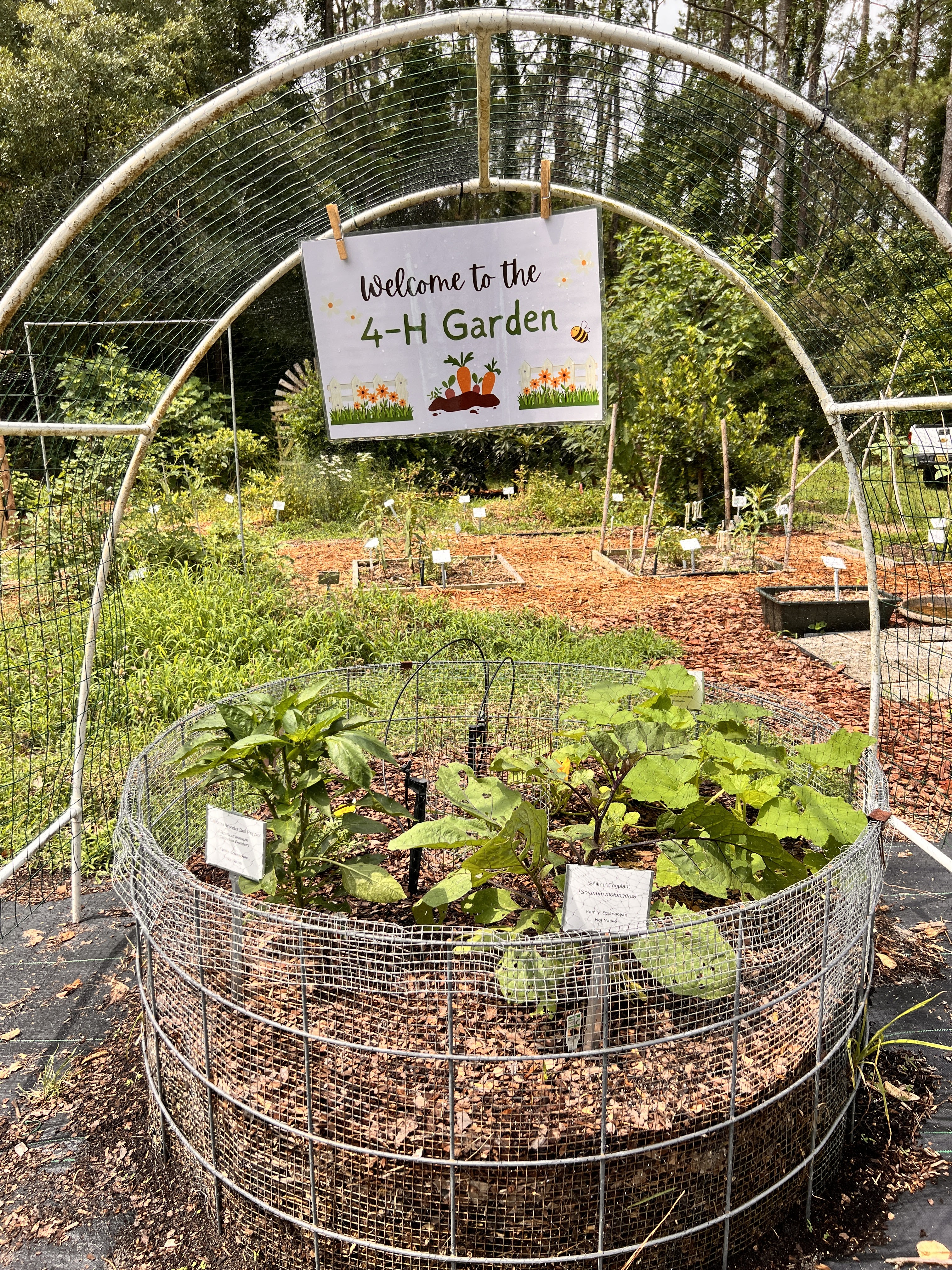
It’s fun to visit the 4-H beds next to
the arbor.  There are raised beds of many
different configurations and materials.  

Just west of the main garden is 
the rain garden, seen here through
the grape arbor just below it.  

We’re really sorry to miss the honey sale 
held each year with the Open House.  The
bees in the hives adjoining the garden
have been gathering nectar from our
plants all spring, including a large stand of
buckwheat which makes delicious dark honey.  

We even have sunflowers planted between
the compost bins.  

Adjoining the compost bins,
Bananas are already forming.  Can
you find them?

From the bananas, we circle around the main
rotation beds back toward the entrance.  
Here an eye-catching feature of the garden is the
cattle panel arches spanning between each of the rotation
beds.  Seen through this arch is the center part of our
garden, including worktable, storage shed, 
compost bins, and seating under shade for rest.

More arches

The arches support tomatoes, beans,
cucumbers—anything that climbs.  

Last, to the right of the entrance as we leave,
and maybe the most important,
are the many perennial and annual
pollinator plants which help
to control pests and to produce
abundant crops on our fruiting plants.
Also in this area are Roselle and yacon.     

Something is blooming at almost 
every time of year.  


Thursday, January 4, 2024

Tallahassee Museum 1880s Garden

The herb garden adjacent to the farm house and
vegetable garden in the Tallahassee Museum 1880s farmyard.  

The VegHeadz Demonstration Vegetable Garden is not the only vegetable garden in Tallahassee tended by Master Gardeners.  

Master Gardener Brenda Buchan has volunteered at the 1880s Garden at The Tallahassee Museum for a number of years. Brenda is our guest host today as she shares information about that garden.  Photos by Brenda Buchan.

“For vegetable gardeners, the Leon County Extension Office houses the Master Gardener’s VegHeads Garden behind Demonstration Bed 5. If you are a home gardener and have small plots or raised beds to plant in this is the perfect place to learn. 

“The Leon County Master Gardeners also host a vegetable garden inside the Tallahassee Museum at the farm house location. It is called the 1880s Garden because the homesites there were built in the 1880s and the herb and vegetable garden reflects what would have been growing at that time. This garden, usually less than an acre, would be considered the kitchen garden that the lady of the household would tend in order to feed her family. It involves planting row crops that could be eaten when ripe, as well as dried or canned, and stored for the winter. During the 1880s, the farm site would also have had a large crop garden, where the crops are sold for income such as peanuts and cotton. That crop would be worked by the men of the household.

“The Leon County Master Gardeners have been working the Tallahassee Museum’s 1880s garden for over two decades now. Twice a year, in the Spring and in the Fall we put in new crops. We use the same methods used during the 1880s including pushing a hand plow and cultivator. The garden is all organic, as it would have been in the 1880s, and any insect problems we have are hand removed or sprayed with soapy water. The crops we plant are also ones that would have been planted at that time and eaten by residents of north Florida. We use composted animal manure to fertilize the crops. I share an anecdotal story at the end of the article about this.

“This garden was started by Glenn Mayne, a long time Leon County Master Gardener, and the methods we use are the same ones his grandfather taught him as a boy while tending his farm in Escambia County, Florida in the 1950s. 

Master Gardeners Mary Jackson and Glenn Mayne
tending the grape arbor at the Tallahassee Museum 1880s farmyard.

“During Spring and Fall, Master Gardeners work the garden on Tuesday mornings. It is common for us to be approached by visitors to the museum asking about what we are planting or the methods we use to tend the garden. We use this opportunity to share our knowledge and to encourage them to try a vegetable garden at home. While we frequently are not there at the time, we know the Museum uses the vegetable garden to teach grade school students about farming when their class visits the museum. For some of the children, they have no idea that French Fries come from potatoes and that potatoes are vegetables and grow underground. We receive a lot of feedback from the Museum teaching staff on how much the children love the vegetable and adjacent herb garden.

“Besides being a community service for the county school children and Museum, the Master Gardeners who work the Garden learn a lot about what row crop farmers must deal with each year. That includes crop rotation, weather conditions, insect infestations, critter management (rabbits, squirrels, deer), and fertilization. 

“The story I wanted to share is yet another lesson we learned this past year. Normally, we do not apply fertilizer to our plants until they have grown approximately eight inches tall and then we only apply it to one side of the crop, the north side. This is called ‘side dressing’ and is done to allow the plant to choose whether it wants to grow towards the fertilizer or not. This past fall, when we went out to plow our small field and prepare it to plant seeds, the Museum had left for us a small pile of composted manure next to the field. Leaving manure out is not a good idea when dealing with children as those ‘Road Apples’ can look too much like a dirt clod that needs to be thrown. So instead of waiting we decided to spread the manure thinly over the entire field and cultivate into the soil before we plowed the rows and planted the seeds. That turned out to be a really bad idea. The seeds did eventually sprout but never thrived. Three months after planting, the crops were still only six to seven inches tall. Lesson learned, we will never spread manure again before planting and we will keep side dressing the rows instead.

“We welcome interested gardeners that want to work with us and learn.”

Master Gardeners David Marshall pushing the cultivator beside the field peas, and 
Marcie Pretorius tying up tomato plants at the Tallahassee Museum 1880s Garden.

Wednesday, February 8, 2023

Wednesday in the Garden

Graphic from USDA

Two items of discussion were on the forefront in the garden on this beautiful spring day—garden rotation schedules and the “Three Sisters.”

The nucleus of the garden rotation schedule we have developed and use at the VegHeadz Garden was obtained from a number of sources and there are many online. Just google garden crop rotation schedules. The trouble is, almost all of them are for more temperate areas and they only have one growing season. So using them as a basis, we had to expand the idea to account for a second season. Many of the rotation schedules are just divided up into four categories—fruit, roots, leaves, and legumes. Ours does much the same, except we have summer legumes and winter legumes which made it necessary to be careful about rotation order to take advantage of nitrogen fixing by the legumes and to use it where it’s most needed.  Another consideration was making sure we didn’t plant small seeds soon after harvesting sweet potatoes due to the allelopathic chemicals left by the sweet potatoes which reduce germination.  

Of course nothing is perfect and some things don’t fit neatly into categories. We have changed the rotation order on the schedule on a number of occasions as gardeners noticed discrepancies or better ways of organizing the rotation so we could achieve our goal which  is to get it as functionally and beneficially as good as possible. 

The current version is available in two forms under resources in the left side bar. We hope you’ll consider using a rotation schedule in your garden.  Planting the same crops, or even crops of the same family, in the same place year after year will increase diseases and pest pressure.  

The Three Sisters   — the planting of corn, beans and squash together, is an item of perennial interest in our garden, and to many gardeners. We have tried it on a number of occasions with limited success. An IFAS article contains much useful and historical information.   Of particular note is the third reference at the bottom of that article which refers to a detailed publication from Cornell University about the Three Sisters.  It is meant as a teaching tool for children ages 9 to 12, and would be great to use in conjunction 4-H or  a school garden.  It also contains a very detailed description of how to plant the Three Sisters as the Iroquois Indians did. We’re going to try it this year. The Cornell publication is available here: 


Thursday, April 18, 2019

Cuban Organic Gardens

Sign for an organic farm in Cuba with a
list of products

While traveling in Cuba with the Hillsborough County Master Gardening Association a couple of years ago, I learned of a technical manual for organic vegetable growing produced by the Cuban Ministry of Agriculture.  I was unable to obtain one while there.  After seeing (and eating) their vegetables produced by totally organic methods in an environment with limited resources, I really wanted to know how they did it. 

Finally, I was able to locate an older copy online in Spanish.  I don't read Spanish and it is over 80 pages long, so I was stumped.  Master Garden Janet Newburgh came to the rescue and translated the entire manual for us, a labor intensive job.   It is very interesting reading for anyone interested in the best way to grow vegetables organically. 

See links below:


Technical Manual for Organic Gardening, Intensive Gardening, and Semi-protected Organic Gardening (English translation by Janet Newburgh)

Thursday, April 28, 2016

Garden at Kearney Center/Homeless Shelter

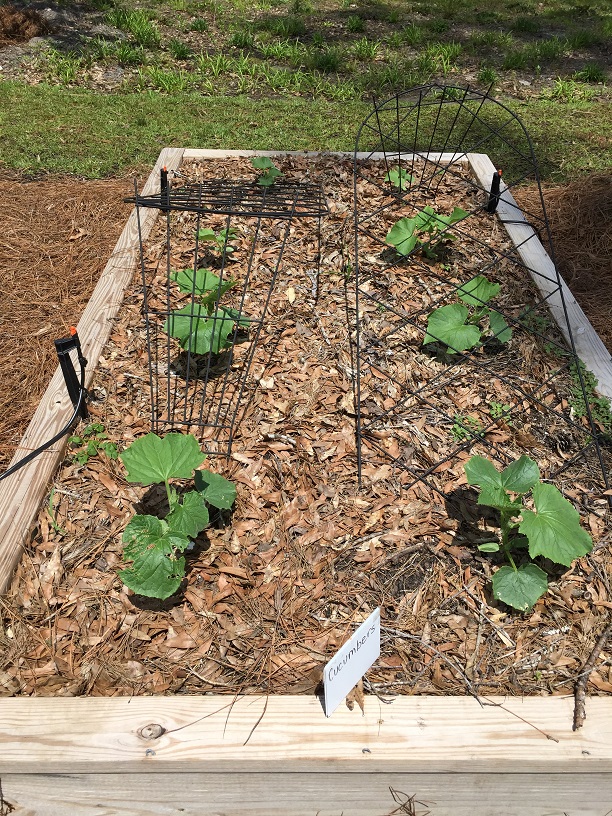
Cucmbers
Spring vegetables have been planted and are growing well.  Micro irrigation has been installed and is working well.  The fall vegetables received rave reviews from kitchen staff and residents.  Everyone is looking forward to the summer harvest of tomatoes, cucumbers, peppers, and eggplants. 
Tomatoes
 

Monday, November 23, 2015

Macon Community Garden Upgrade

 
On a recent Saturday garden members, neighborhood residents, Master Gardeners, and other high school and community volunteers joined together to upgrade the gardens at Macon Community Garden.   Under the guidance of Patricia Byrd and Lizette Kelly, an amazing amount of work was accomplished in just a few hours.

The students were given a short course in using garden tools. Many new raised beds were built, filled with compost, and planted with a variety of fall vegetable seedlings.  The grounds were cleared of some volunteer trees and vines around a big beautiful pine tree at the front of the garden, and a van full of fresh vegetables from Calvary, Georgia were sorted, packed and distributed by the students around the Macon neighborhood.  Vegetables distributed included collards, sweet potatoes, and onions. 

It was a beautiful and productive day, and a good time was had by all. 
 
Patricia Byrd and the ultimate plane for Macon Community
Garden created by an FAMU student volunteer

Lizette Kelly supervising building of garden beds


New beds were quickly put together

Garden Soil and compost on hand
 
And filled with soil and compost

Then the planting began

Soon the new beds and the existing beds were filled with green


An abundance of vegetables for distribution to the Macon neighborhood

The Master Gardener volunteers


Monday, November 9, 2015

Kearney Center Garden


Recently, many volunteers came together to organize and build a garden at the Kearney Center for the homeless.  Master Gardening Student Carroll Murrell coordinated the building project and over a period of a couple of weeks, eight beautiful 8 x 10 raised beds were built, filled with garden soil and compost, amended with worm castings, and planted with winter vegetables.  It is truly a labor of love.  This week, only a few weeks later, the first meal was served using greens and lettuce from the garden to supplement the meal being served.   Thanks to Extension Agent Molly Jameson, to Carroll and to all the many others who contributed to the establishment of this beautiful garden. 

A number of shelter clients participated in the construction and planting.  It is hoped that they will continue to be involved.   Even among the observers there were many reminiscing about childhood memories of family gardens and the delicious meals produced from them.

On the planning board are a micro irrigation system and compost bins.