Showing posts with label Food for All. Show all posts

Saturday, June 22, 2024

Beyond Sustainable Gardening


Our gardening practices at the VegHeadz garden have changed as our awareness of our environmental impacts has increased. There are two overlapping types of gardening for those who want their gardens to be environmentally friendly which are similar, but distinct—sustainable gardening and regenerative gardening. Sustainable gardening aims to do no harm and maintain current conditions. Regenerative gardening goes a step further and seeks to actively improve and restore ecological health, making the garden a positive and integral part of the surrounding environment.

Sustainable gardening focuses on creating and maintaining a garden that meets present needs without compromising the ability of future generations to meet their own. Practices promoting garden sustainability include:

Resource Efficiency: Using water wisely, selecting drought-resistant plants, and employing rainwater harvesting systems.

Soil Health: Maintaining soil fertility through composting, mulching, and minimal use of synthetic fertilizers.

Biodiversity: Planting a variety of species to promote a balanced ecosystem and attract beneficial insects.

Waste Reduction: Recycling garden waste and avoiding single-use plastics.

By implementing these practices, sustainable gardening aims to minimize environmental impact, conserve resources and promote long-term ecological balance.

Regenerative gardening uses these and other methods to not only maintain, but to improve the health of the garden and surrounding ecosystem. Its goal is to heal and rejuvenate the landscape of which the garden is a part, resulting in a net positive impact on the environment. Regenerative agriculture/gardening refers to methods that result in improved soil health, carbon capture, improved biodiversity and healthy water resources.

Soil Regeneration: Building soil health through practices like no-till gardening, cover crops, and the use of biochar to increase carbon storage.

Ecosystem Restoration: Creating habitats in and around the garden area that support wildlife and nurture native plants, restoring any degraded landscape and increasing biodiversity in the area by practices such as reducing turf and replacing with native shrubs and ground covers, controlling erosion and runoff to improve area water quality, and creating conditions favorable to microorganisms. When possible, this includes “wilding” areas to allow nature to restore the habitat with no input other rhan removing invasives.

Regenerative Design: Designing gardens to mimic natural ecosystems, integrating permaculture principles and making the best use of non-renewable resources. An important aspect of regenerative design is creation of a closed system where waste from one element is used as a resource for other elements in the design.      

Carbon Sequestration: Actively working to capture and store atmospheric carbon in the soil and in the plants.

Regenerative gardening includes disturbing the soil as little as possible, keeping the soil covered, providing a continuing supply of organic matter, keeping living roots in the soil, planting more perennials, and placing an emphasis on diversity by planting many different species and varieties, including natives when appropriate, which are more likely to thrive in that particular environment.

Desired outcomes of regenerative gardening include improving soil health (structure, organic matter, and fertility), increasing biodiversity, increasing soil carbon retention, conserving water and improving water quality, maintaining or improving garden productivity without application of synthetic chemicals, and reducing greenhouse gas emissions.

Sustainable gardening is a vital first step in reducing our ecological footprint, while regenerative gardening offers a path toward healing and rejuvenating Earth’s natural systems. 

Both sustainable and regenerative gardening practices are essential for creating a healthier planet and lessening our environmental impact by producing some of our own food and reducing waste generally. A positive byproduct is improved diet, healthier food products, and beneficial exercise. After all, we are also part of the environment.  

This brings to mind the proverbial “butterfly effect” which merely illustrates that small things matter, and we are all connected to a bigger system. Our actions now, today, are the result of previous actions and this can, in turn, lead to a different future. With one small gesture we can change someone's life or help change the world. 

By incorporating elements of both sustainable and regenerative gardening, we, as gardeners, can contribute to a more resilient and thriving environment in our own space and the world in general, recognizing that everything is connected.

Good Source of more information:  SARE— What is Sustainable Agriculture? https://www.sare.org/resources/what-is-sustainable-agriculture/

Wednesday, May 29, 2024

Nature at Work


The real excitement in the garden today was watching nature at work. A small bat had become entangled in the chicken wire around one leg of the garden’s central arbor, which adjoins the bat house.  The bat had no hope of escape, and became a meal for a resident rat snake.  Mr. Rat Snake couldn’t get the bat loose, so we helped him untangle it from the wire then left him alone as he moved away to finish his lunch in peace.  

We were so excited!


Thursday, May 9, 2024

Drawdown Food

“Drawdown: The Most Comprehensive Plan Ever Proposed to Reverse Global Warming” is a best selling 2017 book created, written, and edited by Paul Hawken about climate change mitigation.  There is also a website and a non-profit organization dedicated to promoting research-based solutions to elevated carbon dioxide and other emissions and to provide realistic solutions to climate change.  According to Project Drawdown, food waste and food production are leading causes of climate change.  A new resource for information and solutions is now available on Drawdown Food.  It’s worth exploring to see how we fit into the suggested solutions.  

Wednesday, December 14, 2022

Wednesday in the Garden

Pigeon peas (Cajanus Cajun) have been grown in tropical and sub-tropical regions for thousands of years.   They are a perennial legume related to chickpeas, alfalfa and peanuts. The largest producer is India where they are used as the split pea known as dhal. In the Caribbean, they are a common side offered at restaurants. They can be grown as an annual or as a short-lived perennial, living up to five years.  

We’ve been trying to grow pigeon peas in our food forest at the VegHeadz garden. The first attempt last year was a total failure. This year the peas have flourished, but they have not yet formed pods.  It is said they should be harvested after the first frost, but they better get busy if they are going to make pods in time this year.

We’ve mulched the roots heavily in an attempt to help them make it through the winter in our north Florida area.   More information can be found here: https://plants.usda.gov/DocumentLibrary/plantguide/pdf/pg_caca27.pdf
Pigeon peas

The plants are about 8 feet tall but have remained erect for the most part. Strangely we have a plant which blooms white which is not mentioned in the literature about pigeon peas. All the other plants have yellow blooms which is typical. It’ll be interesting to see if their Pods are any different also. 
Atypical white blooms on 
Pigeon peas

Many varieties of fall greens and salad vegetables were harvested today, and preparation for constructing the new grape arbor proceeds apace, but the major effort today was mulching with the the very nice finely chopped mulch delivered last week. It appears to be from tree trimming as there are green leaves mixed in with the wood chips. The green leaves and wood chips will start composting a little faster than just plain dry wood chips, and the composting process will provide a few degrees of warmth wherever the mulch is placed which should help our plants weather cold snaps nicely.

Mary Janik


Carole Hayes and Peggy McDonald


Carole is getting the job done


While they can’t all be distinguished clearly, pictured here in one corner of the edible forest garden are kumquats, elderberry,  mayhaw, goji, peach, pigeon peas, coneflowers, pokeweed, and lemon grass

The food forest is gaining maturity with plants filling out to increase their spread and shade out weeds. We’re still adding new things, and this fall we have multiple types of cover crops in bare spots to build soil and discourage weeds.  

Friday, December 9, 2022

Growing from Library Seeds


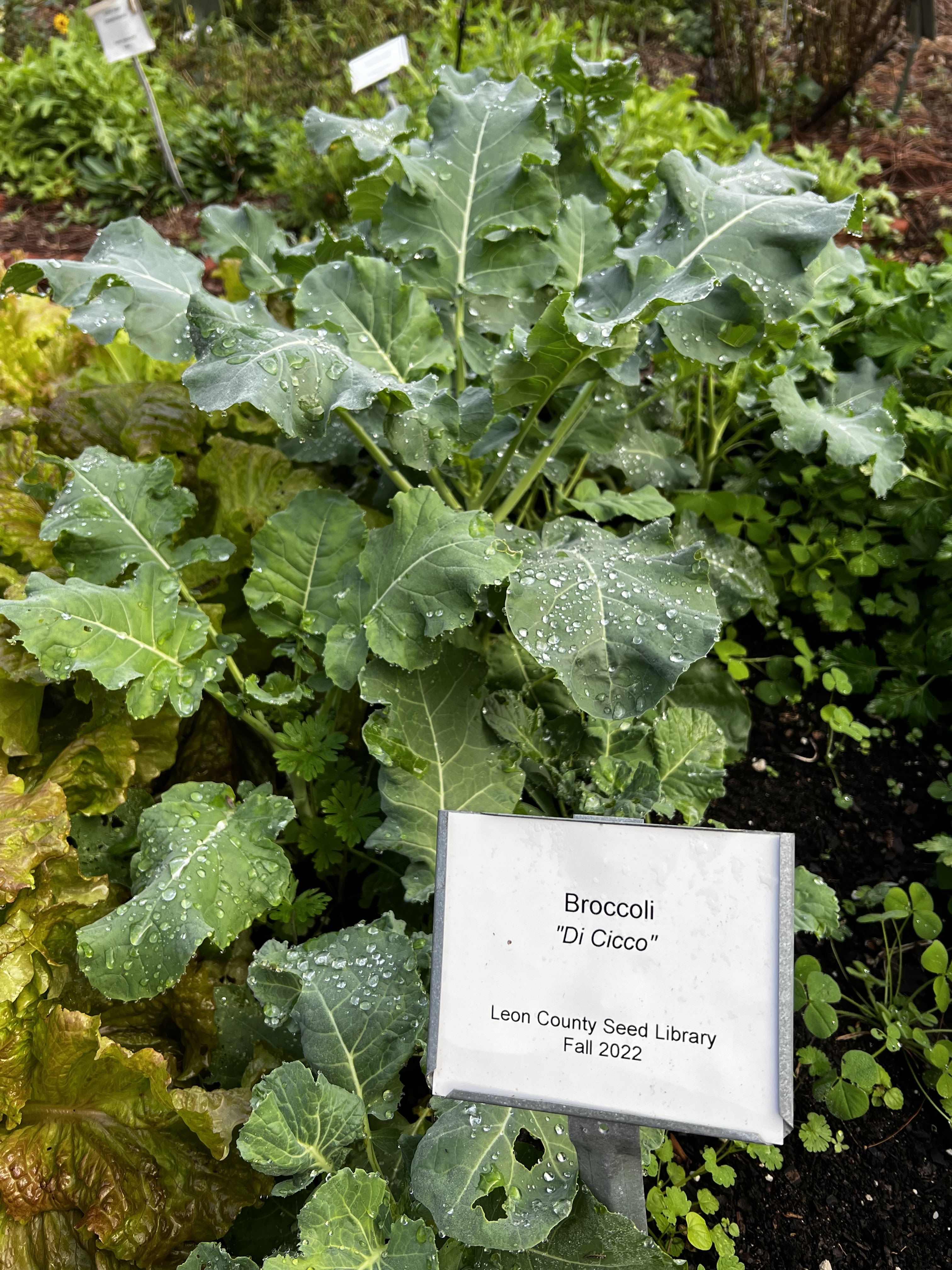
Two raised beds grown from seeds offered by Leon County Library

Each spring and fall the Leon County Library, in cooperation with the UF/IFAS Leon County Extension, offers vegetable seeds appropriate for the season which can be checked out at the library. These small packets usually contain only 10 seeds each which doesn’t seem like enough to grow anything useful. However this is plenty to grow a beautiful garden to feed a family. This fall the list of seeds included:

Master Gardener Jeanne Breland has undertaken a project to plant seeds of each variety offered by the Library each season in the VegHeadz garden for the last several years. Depending on the weather, marauding rabbits, and other factors, her growing efforts have been mostly successful, but this fall her edible results are particularly productive and beautiful and fill two 4’ x 8’ raised beds.  She planted seeds for radishes, carrots and beets directly in the garden   The other varieties she started at home and transplanted seedlings into the garden after they had been growing about four to six weeks. You can learn more about starting seeds and many other gardening techniques from the North Florida Vegetable Gardening Guide in the left sidebar under Garden Resources.


Thursday, April 18, 2019

Cuban Organic Gardens

Sign for an organic farm in Cuba with a
list of products

While traveling in Cuba with the Hillsborough County Master Gardening Association a couple of years ago, I learned of a technical manual for organic vegetable growing produced by the Cuban Ministry of Agriculture.  I was unable to obtain one while there.  After seeing (and eating) their vegetables produced by totally organic methods in an environment with limited resources, I really wanted to know how they did it. 

Finally, I was able to locate an older copy online in Spanish.  I don't read Spanish and it is over 80 pages long, so I was stumped.  Master Garden Janet Newburgh came to the rescue and translated the entire manual for us, a labor intensive job.   It is very interesting reading for anyone interested in the best way to grow vegetables organically. 

See links below:


Technical Manual for Organic Gardening, Intensive Gardening, and Semi-protected Organic Gardening (English translation by Janet Newburgh)

Wednesday, January 20, 2016

Vegetable Seeds for All


Volunteers have been diligently counting and packing seeds for 10 varieties of spring vegetables which will be available at all branches of the Leon County Library beginning February 13, 2016.  This joint project of the Library, Sustainable Tallahassee, and the UF Leon County Extension office is entering its second year and third planting season of making seeds available to anyone who has a library card.

Each library patron can select three varieties to "check out" for free while they last.   Due to the popularity of the seeds last year, the seed supply has been increased, but we suspect they will still be gone in a hurry. Included in the selection are two varieties of tomatoes, two sweet peppers, okra, eggplant, two varieties of squash, basil, and green beans.  All are desirable heirloom varieties which are suitable for seed saving at the end of the growing season to provide seeds for the next year's crop.

February 13 is also an important date for the Leroy Collins Leon County Public Library.  A celebration of the 25th anniversary of the main library at its location on Park Avenue is planned.  There will be a variety of special events, free gifts, and lots of fun, so plan to attend.  The library has thrived at this convenient location in the center of town on the site previously occupied by Leon High School and Lively Technical School in past years.  More information will be available soon through local news sources and on the library website

Wednesday, January 13, 2016

Adopt-A-Garden

It's exciting to learn of all the vegetable gardens around the city at churches, in schools, in parks, and other places.  There are also lots of groups who are thinking about starting a garden.  The Leon County Extension Office is sponsoring a program headed up by Extension Agent Molly Jameson which will provide a hand up to these programs.

Called Adopt-A-Garden, we are looking for volunteers to mentor one or more of these groups.  Volunteers can choose which gardens they are interested in.   Would you rather work with children?  Do you already have a connection with one of them, or live in their area, etc. 

Mentoring might involve just helping to find answers to gardening questions, or pitching in on garden work days, or helping to select seeds and plants which will grow well in the area selected, or teaching gardening skills, or giving or arranging presentation to the group--the type of help and the amount of time involved is  up to the volunteer and the gardening group they have selected.

No need to be a Master Gardener, although Master Gardeners are certainly encouraged to share their knowledge, but anyone with some gardening knowledge or experience, or teaching skills, or just a willingness to learn and find answers along with the group can participate.  All are welcome. 

Check out the Adopt-A-Garden website to find out more, including the list of gardens which have requested help.  We hope you'll consider adopting one of the gardens on the list. 

Monday, January 4, 2016

Leon County Libraries will distribute Vegetable Seed again this Spring - Volunteers needed

Thanks to Molly Jameson, Leon County Extension Agent for sustainable agriculture and community food systems, who is spearheading the library's vegetable seed distribution effort.  Seeds for this spring are in and volunteers are needed to package them.

All work will take place in the board room of the main library, 3rd floor (200 W. Park Ave.)  They will provide refreshments.

If you are interested in volunteering, all you need to do is show up on any of the following dates: 

Seed Packing Dates:
Wednesday, January 13, 2-4 PM
Saturday, January 16, 1-4 PM
Sunday, January 17, 1-4 PM

Wednesday, January 20, 2-4 PM
Saturday, January 23, 1-4 PM
Sunday, January 24, 1-4 PM

Wednesday, January 27, 2-4 PM
Saturday, January 30, 1-4 PM
Sunday, January 31, 1-4 PM

If needed:
Wednesday, February 3, 2-4 PM
Saturday, February 6, 1-4 PM

 Please help spread the word!

Friday, November 13, 2015

Fall Harvesting Has Begun

Buddha packing vegetables for delivery
After several weeks and lots of rain, we returned to the garden to find a lot of weeds--and a lot of vegetables for harvest and delivery to the Kearney Center for the Homeless.  It's very rewarding to be able to share the fruits of our garden.
A cornucopia of fall vegetables and some surprises


We were able to pick a variety of salad greens, radishes, and herbs.  The most pleasant surprise was tomatoes and peppers that had been planted in August.  Thank you Louie for your late summer experiment.  Unfortunately most of our winter greens--collards, kale, etc., have been too ravaged by small caterpillars to share.  We have dusted with Bt (Bacillus thuringiensis) and we hope new growth on the plants will fare better.  Aphids have also been a problem in this warm weather, but we did see a lady bug out hunting.  Watch out aphids!

Just a couple of Better Boys, but still a good
surprise

As usual, the cherry tomatoes did best

Big healthy peppers in November
Other task included weeding, including the nice row of hairy vetch cover crop (not many weeds managed to grow there), and thinning carrots in our container gardens.

Janyce checks for weeds in the hairy
vetch cover crop

Kathy is thinning carrots in one of
our container gardens.  Note the
baby carrot on the adjoining bucket.
They're coming along just fine.

Monday, November 9, 2015

Kearney Center Garden


Recently, many volunteers came together to organize and build a garden at the Kearney Center for the homeless.  Master Gardening Student Carroll Murrell coordinated the building project and over a period of a couple of weeks, eight beautiful 8 x 10 raised beds were built, filled with garden soil and compost, amended with worm castings, and planted with winter vegetables.  It is truly a labor of love.  This week, only a few weeks later, the first meal was served using greens and lettuce from the garden to supplement the meal being served.   Thanks to Extension Agent Molly Jameson, to Carroll and to all the many others who contributed to the establishment of this beautiful garden. 

A number of shelter clients participated in the construction and planting.  It is hoped that they will continue to be involved.   Even among the observers there were many reminiscing about childhood memories of family gardens and the delicious meals produced from them.

On the planning board are a micro irrigation system and compost bins. 


Tuesday, September 9, 2014

Year 'Round Greens

Chaya
Every health article and foodie blog boasts greens as one of the top 10 if not the top 3 healthy foods.  However, here in Florida, greens grow in the winter, and summertime is a greens desert unless you buy imported greens from the grocery store, or use canned or frozen.  

We've done a lot of posts about our perennial vegetable garden and how it's thriving in the summer heat.  Many of those plants provide summer greens with very little attention.   But they're strange, you say?  Actually, they taste much like the familiar greens we enjoy in the winter.  Some require cooking before eating, but others can be eaten raw and used in any recipe you already enjoy, as well as for salads, green smoothies, etc.

We took a salad and a dip to the Master Gardening quarterly meeting to introduce a few of the perennial vegetables we grow.  The two recipes were made with some of the VegHeadz' perennial greens, and they seemed to be a hit. 

The dip was a traditional "spinach" dip made with Chaya and Edible Elephant Ear.   Either or both of these greens are great spinach substitutes.  It is very hard to detect any difference.  The greens need to be boiled for a few minutes to remove harmful compounds, but then they can be used in any cooked spinach recipe.   Click here for the recipe and information on the two greens used.

The salad was a Red Beans and Rice salad to which we added a combination of four fresh perennial greens from the garden.   They were Sweet Potato Greens, Okinawa Spinach, Sochan, and Pacific Spinach (Slippery Cabbage).  These greens can be used raw or cooked.  Click here for the recipe and information on the four greens used.

For more on summer greens, see an interesting article on using the leaves of cowpeas (black-eyed peas, field peas, etc.).

Slippery Cabbage

Monday, February 24, 2014

Hugelkultur - Another way to Garden

Thanks to Gardener Ed for locating all the hugelkulture information you’d ever need (or use) all in one place.  See:  Permaculture Articles by Paul Wheaton where you will find information on hugelkultur--a way to use brush and wood debris in your own yard or garden while creating a sustainable environment for your plants which requires very little watering and no fertilizer.  See also:  The Art and Science of Making a Hugelkultur Bed – Transforming Woody Debris into a Garden Resource, which is a blog post on the Permaculture Research Institute site.  This is a great site for information about reclaiming deserts and wastelands, as well transforming landscapes and environments worldwide into sustainable, resilient food forests. 

Sunday, July 14, 2013

Farmers' Markets for SNAP Recipients

Wireless card machines funded by USDA are helping those receiving aid from the Supplemental Nutrition Assistance Program (SNAP) gain access to the fresh produce available at farmers' markets.  A current article in USA Today discusses the benefits and difficulties involved in the implementation of this program.