Showing posts with label Edible Food Forest. Show all posts

Saturday, August 22, 2026

Time to Harvest Roselle

Photos by Peggy McDonald

Peggy McDonald is the VegHeadz gardener who knows the absolute most about Roselle. She grows it each year at home and in the VegHeadz garden. We call her the Roselle Queen. 

Peggy has started harvesting this year’s Roselle.   Here’s her report. 

The two Roselle, Hibiscus sabdariffa, I planted May 1st, 2026 have started to fruit. 

The calyxes are fully formed a month before the winter solstice when they usually bloom. Obviously the plants could not wait another month. All I did was tie them to a T-post and watch them grow, they are now over 7' tall and 5' wide. These plants do have sprinklers so the drought did not affect them. 

This is actually the third year in a row that my Roselle has bloomed a month early.
 I've included one photo showing how to process the fruit for those new to growing Roselle.
Search Roselle in the right sidebar to learn a lot more about growing, harvesting,  and using Roselle, including some recipes.

I am happy there are no signs of the two spotted leaf hoppers, YET!


Tuesday, February 3, 2026

The Ethnobotany of a Tropical Fruit Market

Thanks to Clara Mullins for directing our attention to this very interesting short YouTube video about a visit to a tropical fruit market in Ecuador. 

There are some fruits and vegetables which you might recognize and many which you will not. Many of these things can be grown in our area.  Several are grown in the VegHedz garden.  Some we have tried with mixed success.  

Then there’s the problem of knowing what processing they need in order to be palatable.  We’re often not familiar with them and they’re not a part of our culture. Maybe this video will give you some ideas.  

https://m.youtube.com/watch?v=9f8lyMwwMSw&pp=0gcJCTMBo7VqN5tD

Monday, December 22, 2025

Pruning Fruit Trees, Shrubs and Vines

A third of blueberry canes 
should be pruned each year
to encourage new growth. 
It’s the season for pruning fruit trees and vines.  A good time to prune most fruits is between now and the end of February, when trees, shrubs, and vines are completely dormant.  Don’t miss the timely on-site workshop in the Leon County UF/IFAS Orchard on Paul Russell Road in Tallahassee.

  Link to Fruit Pruning Workshop Information and Registration

Detailed pruning instructions can also be found here:  https://northfloridavegheadz.blogspot.com/2022/11/pruning-fruit-trees.html

For a complete fruit care calendar for the north Florida area see the left sidebar under Gardening Resources.  


Wednesday, November 5, 2025

Citrus Ripening Season


This grapefruit was still very 
firm and quite tart.  Picked to test
flavor. Fruit on this tree will continue
to sweeten and the pith will narrow. It
should be at peak in several
more weeks.  
Citrus fruits are ripening in North Florida. 

Leaving fruit on the tree has some advantages. The fruit will get sweeter the longer it stays on the tree up to a certain point, and then it begins to get pithy or dry out with loss of flavor. Once the fruit is picked it does not ripen or sweeten any further so it’s important to leave it on the tree until it reaches its peak.

How can you tell if the fruit is ready to pick? Color isn’t always the best indicator of ripeness.  The best way to determine readiness is taste.   Eat a sample from time to time. 

Some citrus varieties hold on the tree better than others.  Mandarins such as Satsumas, Clementines, Tangelos, etc., will not last a long time after maturity.  Their skins will become loose, and their juice will begin to dry up. Lemons can pretty much be left on the tree until you’re ready to use them, and grapefruits become sweeter the longer you leave them.

The bottom line – taste is the key.

Most citrus needs to be picked or protected if temperatures are predicted to go below 28°.  Satsumas and kumquats seem to be the most tolerant of cold temperatures while grapefruits, limes, and lemons will need to be picked or protected when freezing temperatures are predicted.

Two types of mandarins—
Clementines on the left, 
Orlando Tangelos, right.  Orlando 
Tangelo is a cross between
Dancy tangerines and Duncan
grapefruit.  Sweet, juicy, and 
quite cold tolerant. 


A heavy crop of Clementines. 
It has taken a number of years
for this tree to produce tasty fruit.
Clementines are small, a cross
between a mandarin and sweet orange.
These are larger than those you
see in grocery stores because they
were probably pollinated by a
nearby orange tree. They also have
a few seeds for the same reason.   


 Meyer Lemons.  Large and 
sweeter than regular lemons.  

Red Grapefruit - ‘Flame’.  Heavy
bearer of seedless fruit which is
consistently sweet and juicy.  


Cara Cara Red Navel 
Orange.  Developed from a natural
mutation discovered in Venezuela in
1976, the fruit is seedless and delicious
with a unique flavor and exceptional
vitamin content.  They ripen later.

Limequats.  A cross of Key Lime and
Marumi Kumquat.  Small and round,
with tart flesh and sweet rind.  More tolerant
of cold than standard limes.  They can be used when
green or when they become
sweeter as they ripen and change to yellow or
orange.  Unlike other citrus, limequats will continue
to ripen and change color after picking.
They do not have a long storage life 
but last longer when refrigerated.   

Several good references with more information  

https://deepgreenpermaculture.com/2025/03/15/how-to-tell-when-citrus-fruits-are-ripe-a-practical-guide/?amp=1

https://everglades.farm/blogs/news/cara-cara-oranges-origins-unique-qualities-and-uses?gad_source=1&gad_campaignid=21783016276&gclid=Cj0KCQiAiKzIBhCOARIsAKpKLAPepC7qxCBAFRe2rhVK4xlpoolz72jp8NOWvqy8J4CXTADrIU7ewikaAp0CEALw_wcB

https://blogs.ifas.ufl.edu/okaloosaco/2021/12/20/let-citrus-ripen-on-the-tree/


Friday, August 22, 2025

New Food Forest Plants Database for North Florida

Enjoying the cooler shade as we 
learn about designing guilds and selecting plants. 
The VegHeadz have just completed a six session workshop on creating food forest guilds, selecting plants and other aspects of growing a food forest. As a part of our workshop, those participating helped to create a master plant database for our area, growing zone 9a.  The list includes some of the information needed to make selections of plants for your food forest. 

Link to Database.  The most up-to-date version of the database will always be available in the left sidebar of this site under Gardening Resources.

We’ll be adding to and refining the database as we continue to grow in our  small food forest (just 40’ x 70’) in the VegHeadz garden in Tallahassee. In this small space we have over 50 species of plants including over 10 sub-canopy size fruit trees.  We hope this information may be of use to you in selecting plants for your landscape, garden, or food forest. 

In case you think you don’t have room for a food forest, consider watching these brief videos about some tiny forests, any one of which might fit in your space. Thanks to Lorraine, one of our gardeners, for finding this resource.  Small Food Forests and Pocket Forests  


Friday, July 25, 2025

Things That Thrive in July!

The temperature every day hovers between 90 and 100, at night it rarely gets below 80°.   It rains every day, and then the sun shines, creating a steamy humid soup. When you wake up in the morning, your windows are fogged up with condensation from the humidity, even at 5 a.m.  In north Florida, and pretty much anywhere in the Southeast, this is how it is in July. 

All the tomatoes are gone except a few hardy cherry varieties.  The summer squash has slumped and disappeared. The peppers are still hanging on, but they’re not blooming.  You’ve harvested your last green bean and your last ear of corn. The best eggplants have been picked and eaten and okra requires that you go to the garden every day to harvest.  What do you do with that much okra anyway?  Spending time in the garden is a hot sweaty ordeal.

There are some plants which make your efforts worthwhile. Most any type of cowpeas will thrive at this time of year and it’s not too late to plant them. Keep up with your okra and eggplant and they’ll continue to produce throughout the summer and into fall. Nurture your peppers and as soon as the weather cools a little, they’ll start producing again. 

Pictured below are some other plants which will reward you with refreshing flavors and trouble-free gardening. Many of them are perennials which come back every year with no help from you. How much easier can it get?


Thai Ginger (Alpinia galangal)


Galangal blooms.  The leaves can
be used to wrap fish or vegetables
for steaming and the rhizomes 
are used much like culinary ginger. 

Native Dune Sunflower (Helianthus 
debilis) blooms all summer,
comes back every year,
and attracts and feeds helpful 
insects

Mexican sunflower (Tithonia rotundifolia) provides
a wall of blooms along the edge of the garden

Dune sunflowers surround the
pole holding Purple Martin gourds.


Pole beans and a tropical cucumber relative


French Marigolds provide ground cover
and fight nematodes


Gulf fritillaries and many other insects love the Tithonia.   Here they find food, habitat, and prey.  

Okinawa spinach, another heat-loving 
perennial. 


Asparagus provides a wispy contrast
to other garden plants as it stores up
energy for its spring harvest of shoots.


Sochan or Cherokee Greens
(Rudbeckia laciniata) provides
fresh or cooked greens all summer


Jerusalem Artichoke (Helianthus
tuberosus)  This is a
smaller variety – Dwarf Sunray.
Rhizomes provide crunch to 
salads and stir fries.  


Turmeric (Curcuma longa)
grows under the partial
shade of a Loquat tree. Use a 
small knob of the rhizomes in
smoothies; reported to
reduce inflammation. 

Chayote (Sechium edule)
completely covers a large trellis.  
The mild light green fruit can be 
used like summer squash.

Culinary Ginger
(Zingiber officinale)


Comfrey blooms

Comfrey (Symphytum officinale)
Feeds pollinators and accumulates 
minerals from deep in the soil.  


Bitter melon (Momordica charantia) a type of gourd.
We are always amazed when the
melons appear.  The red flesh around the 
seeds is moist and slightly sweet.  Younger green melons are used
in stir fries and Asian stews. 


Native Partridge Pea (Chamaecrista fasciculata) is a
pollinator plant that blooms from spring until frost,  
populated by a large variety of bees, butterflies and
helpful flies and wasps.  It is also a legume, harvesting
nitrogen from the atmosphere for itself and surrounding plants

Friday, July 4, 2025

Chill Hours

Peter’s Curcuma bloom

Something is different about fruit production in our area this season. Many of our master gardeners have noticed that some of their fruit trees are bearing larger crops of fruit this year despite the snow and prolonged cold we experienced during the winter.

Last winter when it snowed, the temperature rarely, if at all, exceeded 45° for a period of at least a week. We had snow on the ground for a full seven days in some areas, an exceedingly rare occurrence here. This substantially increased the number of chilling hours experienced.

Some fruits such as peaches, apples, plums, and others require a more prolonged period of cold than we usually experience in our North Florida area. 

 Chill hours, or chilling hours, refer to the total number of hours during a plant's dormant season (typically winter) when the temperature is between 32°F and 45°F. These hours are crucial for certain deciduous fruit and nut trees to properly break dormancy and begin flowering and fruit production in the spring.  We usually grow varieties here that require less chill hours, but even they benefit from a prolonged period in the specified chilling range.  Hours below 32° do not count toward chilling hours, and other factors also go into the calculations.

In any event, it’s a good fruit year.  One gardener had hundreds, maybe thousands, of plums on two native plum trees in her yard where before there had been very few. Another gardener has so much fruit on her peach tree that the branches are weighed down and three of them broke.

Some fruit bears heavily every other year. Maybe this is the year, or maybe the chill hours have jazzed up fruit production for one season.

What brought this to mind is something unrelated. Master Gardener Peter G. planted a rhizome that was identified to him as turmeric.  It has bloomed beautifully this summer. Turmeric usually doesn’t appear above ground here until late May or early June.  If it blooms, the blooms later in the year at the base of the plant are unobtrusive. 

Turmeric (Curcuma longa)
bloom in the VegHeadz garden. 
Peter’s “turmeric,” which was started from rhizomes obtained from someone at the VegHeadz garden, for the first time bloomed in glorious color with both male and female flowers. The bloom looks very much like a Siam tulip (Curcuma alismatifolia), which is in the same family.   Peter was puzzled.  Clearly it is not turmeric (Curcuma longa) that has benefitted from chill hours or some other environmental influence, but a different variety.  (See comments below for further clarification.)

Nature’s mysteries are one of the things that makes gardening so interesting.

Thursday, June 5, 2025

Wednesday in the Garden

Pole beans and Jelly melons
Despite a threatening sky and predictions of rain, quite a few gardeners spent the morning harvesting and weeding.  Nancy, Dave, Cathi and probably others were digging nutsedge (cyperus spp.) around the G beds (4 x 4 raised rotation beds).  A much larger patch beyond where they were working will probably get some herbicide. We only use herbicide when nothing else works, and nutsedge is definitely a case in point. Even then it only knocks this pest back for a season or a year, only to regain its former territory– so annoying.

The garden still looks good even though it’s June and it’s been hot, but not as intensive as it will be later in the summer. The tomatoes in bed A have been trashed.  Many of us were absent from the garden for several weeks leaving us vulnerable to summer invaders.  

The tomatoes were infested by what appears to be army worms, judging from the damage.  The entire plants were removed so they won’t infect the rest of the garden. Dave’s GMO tomatoes farther down in the garden have not suffered the same fate.  That’s gardening – random disasters, hoped for successes.

The major amount of work done in the Forest Garden by many prior to the open house is holding well, and the pathways are free of weeds and looking good. Next to be planted there are winged beans for the arbor and cowpeas and sweet potatoes in any open space.  The beans will add nitrogen to the soil and the sweet potatoes will deter weeds.  These reliable summer cover crops will also provide a late summer harvest.

It’s always a pleasure to spend time in the garden with friends, beautiful plants, interesting finds, and colorful vegetables and flowers. 

Yarrow


Pollinator plants to attract pollinators
and predators and feed the honey
bees nearby

Kiwano Jelly Melon growing on
the cattle panel arch pictured above.
A climbing cucumber relative. 
Can be eaten at any stage.  Seedy jelly-like 
Interior tastes like a combination of
banana, cucumber, and lime.  
Deters nematodes.

Early row covers and foil covered 
vines have increased our 
success with summer squash 


Sunflowers

An example of biodiversity— eggplants, peppers, basils, cosmos,
marigolds, maybe more.  Although this bed is immediately adjacent
to the worm-eaten tomatoes, there is very little damage
of any kind to these plants. Strongly scented plants and multiple
species and varieties helps to discourage marauding insects.


The terminal tomatoes

Tomato Insect Pest Management:  https://gardeningsolutions.ifas.ufl.edu/care/pests-and-diseases/pests/management/tomato-insect-pest-management/
The tomatoes full of blooms in early May. 
So sad to lose them.  

Tuesday, May 6, 2025

Elderberries

Elderberry blooms in rear,
Oakleaf hydrangea in front

It’s time for elderberries to bloom. You can often see them along roadsides where native varieties that we have ignored all year become apparent with their large clusters of blooms (called cymes, a particular type of inflorescence). Later the large clusters of berries, also called cymes, are less noticeable, but are easily found by birds and other wildlife.

We have a large elderberry tree/bush (Sambucas nigra) in the VegHeadz garden that grows in partial shade. It’s always a pleasure to notice it when arriving on a May Wednesday to work, as it rears its head full of blooms at the back of the edible forest garden.

A recent article in Florida Farm and Family magazine highlighted a family in north Florida that grows elderberries commercially.  The article gives an idea of the products that can be produced from the berries which are harvested in late summer – juice, syrup, wine, balsamic vinegar, and others. Read the article here.  

Like many other dark berries, elderberries are reported to have many health benefits.   Elder flowers also have a pleasant flavor. They can be made into teas, cordials, or used in baked goods, such as cakes or pancakes to provide a unique fragrance and flavor. 

The berries and flowers should not be eaten raw and all other parts of the plant are toxic. They contain a cyanide compound similar to the seeds of apples and peaches, which may cause gastric distress.  Cooking releases the harmful compounds and cooked preparations are safe to eat. 

Don’t let that deter you from using elderberries.   We are often unaware that other foods which we commonly eat should be cooked before eating to remove toxins, including lima beans, kidney beans, lentils, chickpeas and staple plants in the tropics such as cassava.  

Elderberries are easy to grow, and even if not used for personal consumption, are a boon for wildlife.   A paper from the University of Florida tells us all we need to know about growing them.  https://edis.ifas.ufl.edu/publication/HS1390

Whether you grow elderberries or collect them from the wild, you might enjoy a recipe for Elderberry Balsamic Vinegar.  While not technically a balsamic vinegar, elderberry vinegar has the same slightly sweet and syrupy consistency that we all enjoy on salads and many other culinary creations, and can be used in the same way.  

A vinegar qualifies as balsamic if it's made from grape must (unfermented grape juice) and is aged in wooden barrels, typically for several years. The aging process concentrates the flavor and sweetness of the grapes, resulting in the characteristic rich, dark color and syrupy consistency. 

Recipes can also be found online for a traditional spiced but less sweet sauce called pontack or elderberry ketchup, which has been made in England for centuries. It goes well with meats and wild game.  Some say it is similar to Worcestershire sauce. 

Elderberry Balsamic Vinegar 

Pick ripe elderberries (i.e., dark and glossy) from their stalks.  Be careful not to include any green or partially ripe berries, and remove any twigs or leaves.  

Weigh the berries and place them in a large glass or plastic container or bowl. 
For every 12 oz. of fully ripe elderberries, add
2 cups white wine vinegar or cider vinegar to cover the berries. 

Stir and slightly mash the berries, making sure any floating berries sink. 
Cover and place the container in a cool place to steep for 5 to 6 days. Check daily and stir gently.

Drain the vinegar/berry juice using a sieve, cheesecloth or jelly bag to remove the berries. Allow the berries to drain for a prolonged period (up to 24 hours), to extract all the juice. Don’t press the berries or squeeze the bag or your vinegar will be cloudy. Discard the drained berries (compost).

For every 1 cup of vinegar/elderberry juice
Add 1 1/2 cups sugar  

Add the vinegar/berry juice and sugar to a stainless steel or other non-reactive saucepan  Bring to a boil. Stir and simmer for about 15 minutes. The sugar should have dissolved, and the liquid should have thickened slightly. Pour the hot balsamic vinegar into sterilized bottles through a sterilized funnel.  Cap and label. Enjoy as you would any balsamic vinegar.  Store in a cool dark place for up to one year.

Thursday, March 6, 2025

Arrowroot

One of the perennials in the VegHeadz edible forest garden that has thrived is arrowroot (Maranta arundinacea). In fact, it thrives a little too well because it forms larger and larger clumps that we need to control, but it doesn’t get out of hand if we pay attention.

There are a number of different plants throughout the world that are called arrowroot.  The one we grow resembles a ginger plant somewhat and forms clumps of elongated rhizomes underground.  It is an attractive three to four foot dark green plant, a tender perennial that dies back in the winter to re-emerge even stronger in the spring. It is generally resistant to most pest and diseases, and prefers partial shade.

Arrowroot contains resistant starch, has a low glycemic index, 
and is gluten-free.  Foods high in fiber and resistant starch slow your rate of digestion, giving you a prolonged feeling of fullness.  In comparison with other thickeners, such as cornstarch and flour, arrowroot is easier for a grower to process into a form that is useful in culinary preparations 

A recent article by food writer and author Tammy Allgood in USA Today tells us what we need to know about how to use arrowroot.

“By the simplest definition, arrowroot is a thickener. Don’t let the chalky-looking powder fool you because it is powerful. Once you start using it, you’ll understand the attributes quickly and that bottle will gather dust no more.

“Arrowroot comes to us from a rhizome of an identical name that hails from the tropics. The tubers are dug up, allowed to dry, then pulverized into the powdery substance we use in the kitchen.  Some old recipe books call it arrowroot flour, a name Native Americans provided that means 'root flour.' It’s rarely, if at all, called that anymore.

“Arrowroot has a distinct advantage over other thickeners like flour and cornstarch.  It is odorless and tasteless and becomes clear as it cooks. That makes it a prize to use in everything from puddings to sauces plus it has nearly twice the thickening power.

“Like cornstarch, it is best to mix with a cold liquid before it’s added to hot ingredients.”

To prepare arrowroot from rhizomes, you need to dig up the arrowroot plant, carefully wash the rhizomes, peel off the outer layer, then grate or finely chop them, mix the pulp with water, let the starch settle, pour off the liquid, and then dry the remaining starch to create arrowroot powder; this process involves removing the bitter compounds by repeatedly washing and settling the starch with water. 

Key steps for processing arrowroot to produce powder or “arrowroot flour:“
  • Harvesting: Harvest arrowroot rhizomes when the plant is mature, usually in the late summer or early fall. Dig up the plant, carefully removing the rhizomes from the soil.  Select plump and firm rhizomes for the best quality starch. 
  • Cleaning: Wash the rhizomes thoroughly to remove dirt.
  • Peeling: Peel off the tough outer layer of the rhizome using a knife.
  • Grating: Grate the peeled rhizomes into a fine pulp.
  • Mixing with water: Add water to the grated pulp and stir well.
  • Sedimentation: Let the mixture settle, allowing the starch to separate and sink to the bottom.
  • Decanting: Carefully pour off the clear liquid, leaving the starch behind.
  • Rinsing: Repeat the process of adding water, settling, and decanting several times [as many as ten times] to remove bitterness.
  • Drying: Spread the wet starch on a flat surface to dry completely.
  • Grinding: Once dry, grind the starch into a fine powder, which is now your arrowroot flour.  Producing a fine powder ensures that it will dissolve easily in liquids.

Sunday, December 8, 2024

Forest Garden Vines—Bitter Melon and Chayote


Bitter Melon 
(Momordica charantia)
A visitor thought he found a strange creature in our garden a week or so ago.

Master Gardner Yen Chen several years ago planted some bitter melon seeds for plants to climb the arbor leading into our forest garden. It has thrived and reseeded each year to cover at least half of the arbor. Like so many unfamiliar things, we have admired it and wondered how to use it, but haven’t really figured that out yet.  The leaves are attractive, it doesn’t get carried away with its growth and take over, and the fruits are fascinating. 

There are quite a few different varieties of bitter melon, which is in the cucurbitacae family along with cucumbers, squash, and gourds. The variety we are growing is about four or five inches long, green, and warty, and is probably an Indian variety. There are also Chinese varieties which are longer, smoother, and sometimes more bitter.  It is one of the most popular vegetables to grow in China and a number of other Asian countries.  

Asian cuisines include bitter melon in stir fries, soups, and salads.  It is often salted briefly, like eggplant or cucumber, or blanched to reduce its bitterness. It is widely reported to have significant health benefits, and is an important part of the diet on Okinawa where many people live beyond 100 years.  Bitter melon is credited with contributing to their longevity.

When the fruit matures, it turns golden yellow to orange and opens up, revealing bright red globules, called arils, which contain the seeds.  Actually, it looks carnivorous, and we keep expecting it to say “Feed me!“

The red flesh around the seeds is sweet and juicy.   The seed inside each moist globule should not be eaten.   

The seeds don’t germinate until the ground is quite warm, the vines grow throughout the summer and bear fruit midsummer through fall, until cold or freezing temperatures kill it back.  

It has been growing in an area of our garden which has no irrigation and it has not been fertilized. We have noticed no pests or diseases on the healthy vines.

More information:  https://edis.ifas.ufl.edu/publication/HS1271

Chayote or Mirliton
(Sechium edule)


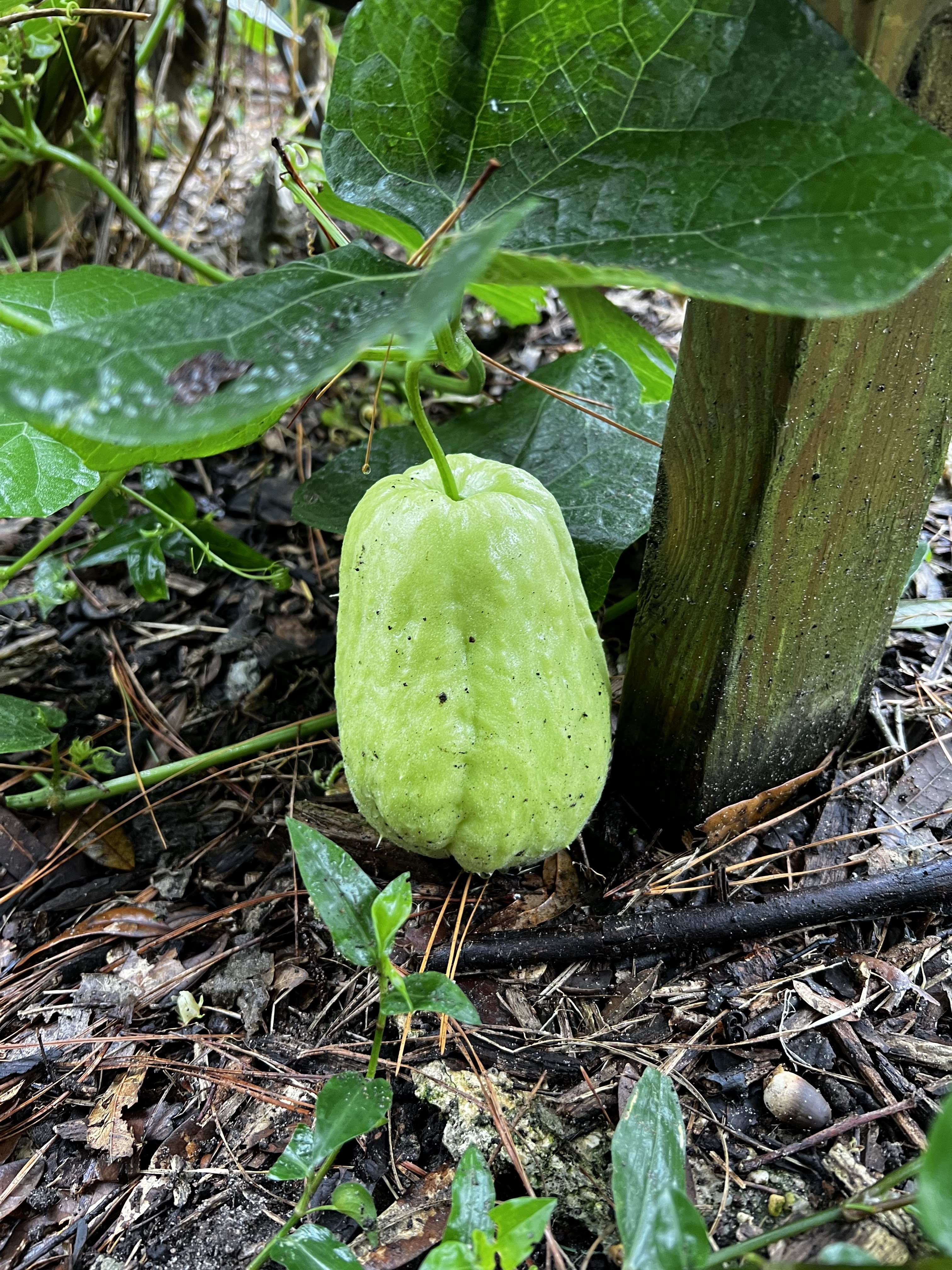
Another vine which dependably returns each year is the Chayote, also a cucurbit. It is a sub-tropical perennial which returns from the roots, getting a late start and concealing its abundant fruit under the leaves. We often don’t recognize that we have a bumper crop until the leaves start to die back in the fall, revealing fruits that had been hidden from us.  It needs so little care that we forget about looking for fruit. 

It too is growing in our forest garden without irrigation and without fertilization, although we do mulch and grow cover crops in the area to add organic matter to the soil.  The spent vines and leaves are piled around the base of the plant to add more organic matter and insulate the roots over the winter.  

We haven’t noticed any of the diseases and pests which usually plague cucurbits in our area.  It is a large plant and the fruits are heavy, so you will need a substantial arbor to support it.

Most of the plant can be eaten, including the tubers, and it is also reported to have many health benefits. It is a popular vegetable in areas where it grows, and is produced commercially in Costa Rica and other tropical areas. You don’t often see it in grocery stores, so it is relatively unknown in other parts of the country.  In Louisiana it is used as a seasonal vegetable referred to as mirliton, and is often seen on Thanksgiving tables.

The sturdy Chayote fruit can be used much like squash, cucumbers, or potatoes.  It’s firmer than summer squash and is similarly mild in flavor.  If left on your counter for several weeks, it may sprout from the blossom end and begin to occupy your kitchen. It can be planted in the soil with the sprouting end exposed but the sprout should have contact with the soil in order to develop roots.  It should be protected from freezing temperatures. We haven’t tried overwintering one in a pot to be planted in the soil when weather warms. Perhaps we’ll do that this year.

More info here and here.  

Chayote sprout