Showing posts with label Vegetable Gardening Resources. Show all posts

Wednesday, August 27, 2025

Timing is (Almost) Everything

We’re starting to think about fall planting, ordering seeds and starting some plants in flats.  When planning your garden each season, timing your planting is of utmost importance.  

North Florida generally has two main gardening seasons—a shorter spring/summer season for warm-weather crops and a longer, more productive fall/winter season for cool-weather vegetables, while the intense heat and humidity of mid-summer is only suitable for a few varieties.

Different vegetables are adapted to different temperature ranges.Warm-season crops are sensitive to cold and will not grow—or will be severely stunted—if planted when soil temperatures are too cool. This includes tomatoes, peppers, and cucumbers.  Conversely, when temperatures get too warm, the same plants will stop blooming and setting fruit. They must be grown within a distinct range of average temperatures.

Cool-season crops prefer different conditions. They may "bolt" (prematurely produce flowers and seeds) if they mature in excessive heat, which can cause the leaves to become bitter. This applies to leafy greens like lettuce and spinach as well as hardier greens like kale, collards, and mustard.  Proper timing aligns your plants with the natural cycles of nature and provides ideal moisture and light conditions, allowing for strong root development and healthy growth.  

It’s always a good idea to plant earlier in the suggested range.  Early planting in spring will allow crops to mature for harvest before the crush of bugs and diseases.  Early planting in fall will allow seeds to germinate and crops to get started before cool weather slows them down.  Some crops may need protection when planted early.  In the fall, depending on the heat level, earlier plantings may need to be protected with shade cloth from over-exposure to sun and heat and to discourage late summer bugs.  In spring, tender seedlings may need to be protected with frost cloth from late freezes.  

Practice succession planting.  Plant small batches of the same crop every few weeks throughout the planting window.  This will ensure a steady supply of vegetables and improve your chances of hitting the environmental sweet spot for temperature, light, etc.  Every year is different. 

Choose the right varieties: Select vegetable varieties that are recommended for the north Florida climate. Local nurseries are a good source for varieties appropriate for our area.   

This probably sounds somewhat confusing. It is difficult to keep up with, particularly if you’ve recently moved from another part of the country and are accustomed to a totally different planting schedule. The Red Hills Small Farm Alliance has developed a planting calendar particularly appropriate for our unique area.  It can be relied upon to keep you on track with the correct dates for starting seeds, planting seedlings and direct sowing.  The planting calendar and monthly gardening advice from Gardener Ed are available in the left sidebar to let you know what to plant each month.

Or follow our links to two different versions of the planting calendar. One can be printed or saved, the other will import a Google calendar with the same information, which you can turn on and off in your calendar app to keep you up-to-date each month on what should be planted then.  We find that both calendars are useful. The printed one is good for planning your garden, determining what seeds to order and when, deciding when in a planting window is best to plant, and getting a sense of gardening seasons. The calendar app is great for deciding what seeds and seedlings to buy locally and what to plant on any particular day that you have time to spend in the garden.


Same information for import to a Google calendar:  Link to Google calendar. Or use the QR Code below.  When you access the link or the code, an option should pop up to download the planting calendar. If you have trouble accessing it on your phone or iPad, try a laptop or desktop computer. Once you have it downloaded, it will appear as an optional calendar on any of your devices. You can turn it off or on by selecting the planting calendar in the menu of your calendar app.  

The app was created by local gardener Liz Hammock. Here’s her take on gardening and how she uses the calendar app: 

“My early childhood was spent on a small farm in rural middle Tennessee and being in the garden feels essential. The resources supplied from Red Hills and Master Gardeners and the Extension office have been really helpful for me to get oriented to gardening in this climate. 

My career is indoors and my gardening time is more limited than I would like. I noticed I was spending perhaps too much of my very limited gardening time reading and sorting my seed packets rather than actually putting seeds in the ground and letting the sun and rain take it from there (my compost pile contributes too). It occurred to me that I really needed something to tell me what to put in the ground the next time I could be in the garden. 

The planting guide that was already available just needed to be on my phone to be used - at the store if I needed to pick up seeds or in the garden when a new spot opened up. Having the planting guide in calendar form has already transformed my own gardening time- less planning and more doing. The calendar quickly turns my garden dreams into action by telling me what to put in the ground today. I certainly could not have done it without the guide that Red Hills distributes freely. I hope many people will benefit!”

Friday, August 22, 2025

New Food Forest Plants Database for North Florida

Enjoying the cooler shade as we 
learn about designing guilds and selecting plants. 
The VegHeadz have just completed a six session workshop on creating food forest guilds, selecting plants and other aspects of growing a food forest. As a part of our workshop, those participating helped to create a master plant database for our area, growing zone 9a.  The list includes some of the information needed to make selections of plants for your food forest. 

Link to Database.  The most up-to-date version of the database will always be available in the left sidebar of this site under Gardening Resources.

We’ll be adding to and refining the database as we continue to grow in our  small food forest (just 40’ x 70’) in the VegHeadz garden in Tallahassee. In this small space we have over 50 species of plants including over 10 sub-canopy size fruit trees.  We hope this information may be of use to you in selecting plants for your landscape, garden, or food forest. 

In case you think you don’t have room for a food forest, consider watching these brief videos about some tiny forests, any one of which might fit in your space. Thanks to Lorraine, one of our gardeners, for finding this resource.  Small Food Forests and Pocket Forests  


Thursday, May 9, 2024

Drawdown Food

“Drawdown: The Most Comprehensive Plan Ever Proposed to Reverse Global Warming” is a best selling 2017 book created, written, and edited by Paul Hawken about climate change mitigation.  There is also a website and a non-profit organization dedicated to promoting research-based solutions to elevated carbon dioxide and other emissions and to provide realistic solutions to climate change.  According to Project Drawdown, food waste and food production are leading causes of climate change.  A new resource for information and solutions is now available on Drawdown Food.  It’s worth exploring to see how we fit into the suggested solutions.  

Saturday, January 27, 2024

Dooryard Fruit Care

A new resource is available on the VegHeadz blog—a North Florida Dooryard Fruit Care Calendar.  For those who have fruit trees or who aspire to grow some, this is a helpful aid to prompt you when to plant, fertilize and prune.  

The reference links included provide additional important information.  

Dooryard fruit doesn’t need a lot of fertilization if they are planted in loose, fertile soil and consistently mulched.  The fertilization schedules recommended in the references have been adjusted on the calendar to allow you to fertilize almost all of your fruit at the same time.  However, you should be aware of the fertilizer needs for each variety as some, like blueberries and citrus, need an acidic fertilizer and others a more neutral type.  

This calendar is under development and we welcome comments, suggestions and questions in the comment section below.  The calendar is available in the left sidebar and at this link:  

https://drive.google.com/file/d/1XEmFrZHuVDZSdRZ-8FkNsk8uaJKDaIj9/view?usp=drivesdk

Thursday, January 25, 2024

Biochar


This week, Leon County leaders voted to make permanent a test program under contract with the engineering company ReCap to turn yard waste into a carbon-negative material called biochar. Carbon negative means the product or process offsets more carbon, through carbon capture, sequestration, or avoidance, than it contributes to the environment. 

Biochar is essentially charcoal, or wood which has been partially burned at very high temperatures in anaerobic conditions to create a stable product which will sequester carbon for many years while rendering benefits to soil and plants.

Extension agents have been able to secure a large bag of the biochar which will be tested in the VegHeadz garden. We will add prescribed amounts to our mix of topsoil and compost. Biochar is said to benefit the soil in many ways including better water retention, balancing pH, immobilization of heavy metals, and providing a medium for increasing microorganism populations.

Additional information and resources are available in the left sidebar under Gardening Resources. These should be studied carefully as there are also some drawbacks. Biochar tends to increase soil alkalinity and can deplete nitrogen when applied. It should be used in small amounts and plants should be monitored to assess results. Once added to the soil, it cannot be removed.

The county resource management department intends to make biochar available to the public along with the currently available mulches and compost. Availability can be determined by calling the solid waste department.

Below are links to additional interesting reading reflecting the many ways in which waste is being recycled, repurposed, and managed by our county government:

Solid Waste Managment website: https://cms.leoncountyfl.gov/Home/Departments/Office-of-Resource-Stewardship/Solid-Waste

Leon County Resource Stewardship website (includes oversight of Sustainability, Solid Waste, Parks and Recreation, and UF/IFAS Leon County Extension): https://cms.leoncountyfl.gov/Home/Departments/Office-of-Resource-Stewardship

2023 report of Leon County Office of Resource Stewardship: https://drive.google.com/file/d/1Qy577JpdhTSEin3cIJ8vmCsCtH1FFOWA/view?usp=drivesdk

Thursday, January 11, 2024

A Cautionary Tale

Photo by Peggy McDonald

A soil test last fall revealed that some of the VegHead Garden’s beds are quite high in copper, particularly those where we have added a lot of commercial garden mix created from animal manure.

While composting has been shown to reduce the bioavailability of copper and other heavy metals, they can still accumulate in the soil.   This can affect germination rates and plant growth.  Copper also has antimicrobial qualities which can reduce the activity of essential microorganisms in the soil. 

It has long been known that composted animal manure tends to be high in copper because of copper that is added to animal feed for domestic animals to help furnish minerals for animal nutritional needs and because of its antimicrobial characteristics.  This includes mushroom compost, which is usually created from animal manure, blood meal and grain straw.

We had been using bulk garden mix from local suppliers, and following the soil test, we were looking for alternative products to top up our garden beds and provide nutrients to our crops.  When extension agent Mark Tancig contacted Black Kow to see what the copper content was in their commercial product, they confirmed that it was also high in copper. They graciously donated many bags of their 100% cow manure compost to us, which we will use with the addition of an equal amount of garden soil, potting mix, or our own compost, which is free of manure.  This will dilute the copper concentration to which the plants are exposed as well as any other heavy metal residue   

Soil tests are recommended to not only test for copper, but  potassium and phosphorus as well as soil pH   Proper levels of all these elements are essential for your garden to thrive, Soil test kits can be obtained from the Leon County Extension office on Paul Russell Road.   

Thursday, January 4, 2024

Preparing Your Garden for Spring Planting

We enjoyed the previous post by Master Gardener Brenda Buchan so much we thought this would be a good time to mention the article she wrote about preparing our gardens for spring planting.  This is something we should all be thinking about now.  

Spring Veggie Garden Prep:  http://blogs.tallahassee.com/community/2023/02/14/spring-veggie-garden-prep/

This and many other gardening articles written for publication in the Tallahassee Democrat newspaper and posted on the Tallahassee.com community blog can be accessed here: http://blogs.tallahassee.com/community/category/tlh-home-garden/

Also see our previous post highlighting information from Nathan Ballentine, “The Man in Overalls” about preparing your garden beds for the next planting season: https://northfloridavegheadz.blogspot.com/2022/09/how-to-prepare-you-garden-for-new-season.html

Glenn Mayne, Brenda Buchan, and David Marshall working in the
Tallahassee Museum 1880s Garden. Photo by Mary Jackson.


Saturday, November 11, 2023

Hugelkultur

Hugelkultur bed at
 VegHeadz garden
If you follow this Blog, you’ve heard us talk frequently about our hugelkultur bed. This is a German word meaning mound culture.  It stems from early European gardening practices and was adopted and adapted by the permaculture community because of its many gardening and environmental advantages   

The benefits of hugelkultur can be achieved by growing in mounds built over logs and other organic material, or in traditional looking garden beds by making them deeper and adding logs, branches, and other organic matter before filling the bed with garden soil.

In addition to the hugelkultur bed in the VegHeadz garden, when the raised beds were built, we filled the bottoms with oak logs, banana trees, leaves, and whatever other organic matter was at hand. We then filled the beds with garden soil mix and compost. As the organic matter at the bottom has decomposed, the level of the beds slowly lowers and we’ve added compost and garden mix at the top. 

A variety of rough organic
materials were added to our
raised beds before garden soil.  

What are the advantages of hugelkultur gardening?

  • Carbon sequestration.  Carbon from the organic matter in the bottom of the bed is sequestered in the soil as the material decomposes. Whatever we can do to capture carbon is a benefit to the environment.
  • Less waste. Instead of tossing yard waste, like fallen branches and leaves, these materials are repurposed to provide benefits on site. 
  • Less watering. As the organic materials at the base of the bed decompose, they hold water like a sponge, helping to keep garden soil consistently moist and reducing watering requirements.  
  • Less fertilizer. As the natural materials in the bed break down, they release nutrients into the soil, creating compost in situ.  Decomposed wood creates some of the best, most pH balanced compost.  It’s been nourishing forests since the beginning of time.  
  • Kind to backs.  Hugelkultur beds are built above the ground as high as you’d like,  so you won’t need to bend over as far to tend them.
  • Season extension.  As the base organic material decomposes, it generates some heat. Thus soil warms up slightly sooner in spring and a few degrees are added to the garden microclimates as frosts approach.
  • Good for heavy feeding plants. Pumpkins and other squashes are voluminous plants and heavy feeders.  In a hugelkultur bed they will have all the nutrients they need and more room to grow as they cascade down the sides of the mound. 
  • Good growing option for poor soils.  It’s hard to grow in sand or heavy clay soils, but hugelkultur beds are built on top of existing soil, allowing you to grow a garden even if you have very poor soil.
  • They’re also good for small spaces because you can grow on the top and the sides of the bed providing room for more plants in less space.  
  • In raised beds, they reduce the amount of soil needed to fill the bed.  Only the top six to eight inches need to be garden soil.  Much less expensive if you are buying garden mix or compost to fill your beds.  
  • No tilling needed and less weeding.  The seed bank (latent weed seeds in the native soil) is not activated.  
The main disadvantage to this type of garden bed is that it takes some organization and a good deal of effort to construct it. If you do not have suitable materials on site, locating materials is another hurdle.

See this earlier post for more information and resources on Hugelkultur and detailed instructions on how to build a bed.  https://northfloridavegheadz.blogspot.com/2014/02/hugelkultur-another-way-to-garden.html

Hugelkultur bed in garden of Regine Malign-Lynch in Betton Hills, Tallahassee

Hugelkultur bed on property of
Anna Lee in southeast Leon County, Florida


The VegHeadz hugelkultur bed 
created by MG Peter Goren
has many layers

Digging the trench for base layer 

Layers of logs, branches, leaves,
and wood chips 

Final layer of garden soil and then mulch 

Hugelkultur bed planted with cowpeas and Seminole pumpkins.  
Trellises to support Giant sunflowers now provide space for
the cowpeas to climb.  


Friday, January 13, 2023

Getting Ready for Spring Planting

It’s time to start your spring seedlings for tomatoes, peppers, eggplant, and many other spring vegetables. If you have a really bright window, you might be able to grow these inside without a grow light.  We feel the best approach is to purchase a relatively inexpensive grow light set up, and possibly a heat pad if you have cooler temperatures in your home or wherever you’re going to be growing the plants.   

At the very least it’s time to order your seeds for both spring and fall crops. If you wait until summer to order your fall seeds, they may be out of stock. That’s been happening in recent years.  

Instructions for starting seeds under grow lights can be found here, and instructions for building your own at even less expense can be found here

This is also the time to get a soil test. If you want to add soil or amendments to your garden to produce the most successful crops, a soil test is essential. Pick up a soil test kit from the UF/IFAS Leon County Extension on Paul Russell Road and follow the instructions for gathering your samples and sending them to Gainesville. Response is usually received by email within a week or so and you’ll have plenty of time to add the necessary amendments to your garden.

We’ve created a new soil amendment reference available on the left side bar under Resources that details the amendments which will provide the nutrients you want. It can also be accessed at https://drive.google.com/file/d/1mlx54uYqsD3p7GZk8U8H_AR0gcG6ecH3/view?usp=drivesdk.

We hope this year produces your best garden ever.

Friday, December 9, 2022

Growing from Library Seeds


Two raised beds grown from seeds offered by Leon County Library

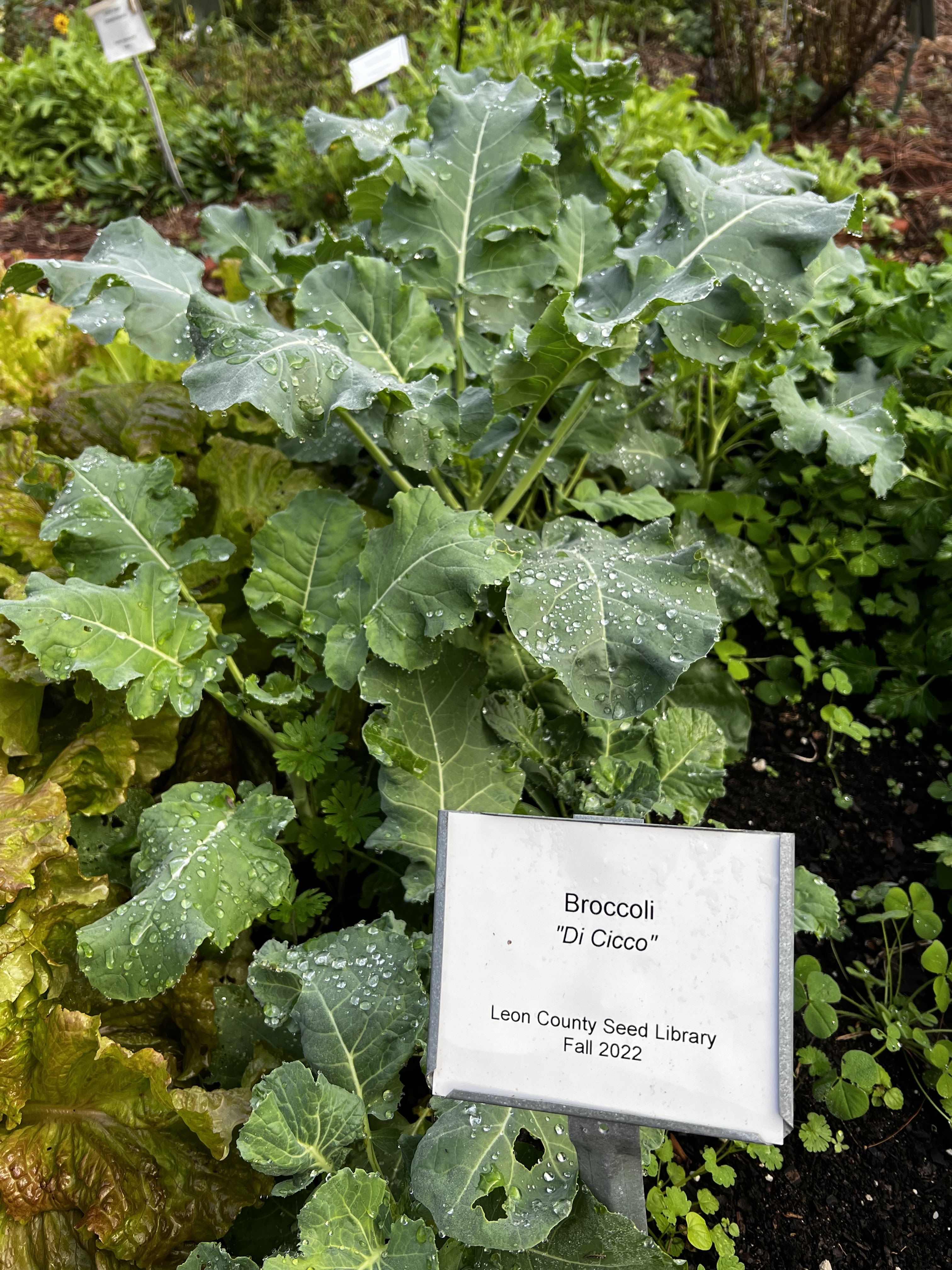
Each spring and fall the Leon County Library, in cooperation with the UF/IFAS Leon County Extension, offers vegetable seeds appropriate for the season which can be checked out at the library. These small packets usually contain only 10 seeds each which doesn’t seem like enough to grow anything useful. However this is plenty to grow a beautiful garden to feed a family. This fall the list of seeds included:

Master Gardener Jeanne Breland has undertaken a project to plant seeds of each variety offered by the Library each season in the VegHeadz garden for the last several years. Depending on the weather, marauding rabbits, and other factors, her growing efforts have been mostly successful, but this fall her edible results are particularly productive and beautiful and fill two 4’ x 8’ raised beds.  She planted seeds for radishes, carrots and beets directly in the garden   The other varieties she started at home and transplanted seedlings into the garden after they had been growing about four to six weeks. You can learn more about starting seeds and many other gardening techniques from the North Florida Vegetable Gardening Guide in the left sidebar under Garden Resources.


Saturday, June 11, 2022

Gardening Myths


There is a lot of lore surrounding gardening. Many of the “remedies” and taboos do not apply to our unique growing area, many are questionable with no available scientific backup, and many are just unsupported myths. How do we determine if there is any gold among the rubble? 

A good place to start is the website maintained by Dr. Linda Chalker-Scott of the Washington State University Extension called “Horticultural Myths” and her podcasts on “The Informed Gardener.”   Also, see the article by Extension Agent Trevor Hylton, “Gardening Snake Oil.”

One area that is fertile ground for myths is companion plants.  We have a lot of reservations about companion plant information.  See more here:  


It’s time we did some informal research of our own with plants that have compatible growing seasons and environmental needs in our North Florida area.  We’ve already started with our cover crops, pollinator plants, nitrogen fixing plants in the forest garden, and interplanting marigolds, alyssum, buckwheat and herbs with our vegetables.  Also see our previous post with photos of our giant sunflowers as trap plants for leaf footed bugs.   We’ll let you know how it goes as we try out other companions.   


Wednesday, January 5, 2022

A study in Marigolds and Mulch


VegHeadz gardeners have planted marigolds in various ways following information about their ability to repel nematodes and to attract pollinators to the garden. 

After temperatures in the low 30s over the last week, when we worked in the garden today we noticed a striking difference in how two beds of marigolds reacted to the cold. In a raised bed planted by MG Jeanne Breland, a marigold cover crop was bitten back quite severely by the cold. Planted there was a variety sold as “French marigolds,”   probably  “tagetes patula.”   

Cold-damaged
French Marigolds

About 20 feet away and at a slightly lower elevation three varieties including “tagetes patula” planted by MG Kwan Park to attract pollinators showed no signs of damage from the cold. 

So what was the difference? The marigolds in the raised bed which were damaged had been mulched two weeks ago with dry tree leaves. The light brown leaves had not yet begun to decompose to any extent.

Undamaged Marigolds
Marigolds in the lower bed were mulched last week with a layer of partially composted fine mulch from the Leon County’s solid waste facility. This dark mulch had been sitting in a pile in our garden area for some time and had begun to decompose. Our theory is that the sun heat absorbed by the dark color of the mulch and the heat from the composting process made enough difference in the ambient temperature in that area to protect those marigolds from the cold.

The takeaway is that a compost mulch in fall will not only provide nutrients for your spring crops and discourage winter weeds, it may provide some cold protection to nearby plants.  Sometimes a small bump in temperature means the difference in winter survival.

For the bottom line on marigolds and nematodes, see the IFAS article below.  https://edis.ifas.ufl.edu/pdf/NG/NG04500.pdf

Among other things, this article points out that the best way to utilize marigolds for control of nematodes is to plant them thickly as a cover crop as Jeanne did at least two months before the next vegetable crop and in the exact place where the next crop will be planted.   The marigolds do not repel nematodes, they actually attract them.  The marigolds act as a trap crop when the nematodes invade their roots, cannot develop further, and die because of a chemical secreted by the marigolds.  This benefit lasts only one season.

Marigolds planted to attract pollinators can be planted anywhere throughout your garden   

There’s much more to learn, so check out the article.


Thursday, July 23, 2020

Updated Square Foot Vegetable Planting Guide


Molly Jameson, Leon County UF/IFAS Extension Agent for Sustainable Agriculture and Community Food Systems has updated her square foot vegetable planting guide. It is designed to provide planting dates for our area in northwest Florida. This valuable resource reflects when to plant vegetables throughout the year from either seed or transplants as well as how many plants can be sustained in a single square foot of gardening space. The guide is available on this blog under Gardening Resources in the left sidebar or from this link.  Square Foot Vegetable Planting Guide for Northwest Florida

Tuesday, May 12, 2020

One-Stop Vegetable Gardening Source

https://gardeningsolutions.ifas.ufl.edu/get-growing/ 
UF/IFAS has launched a new one-stop source for vegetable gardening in Florida—Sustainable Home Food Production.  With one click you can access the many, many resources offered for beginning and experienced gardeners alike.  On-line workshops, articles, and research papers are available on gardening 101, fruit production, diagnosing garden problems and much more.  We’ll be referring to it often.

Thursday, October 10, 2019

More about Roselle and a Couple of Great Resources

If you want to know more about sustainable gardening and topics such as pest management, cover crops, and soil health, SARE is a great resources, Sustainable Agriculture Research and Education which is funded by the USDA to further sustainable agricultural practices and implemented by a number of Universities around the country.  It’s southern arm SSARE, operates out of the University of Georgia and provides information and funding to further sustainable agricultural practices In our region.  We have found their information to be extremely helpful in developing the gardening practices we follow today. 

Another newly discovered and comprehensive source of information on growing edibles in Florida is Growables.org--Grow Florida Edibles.  This site, started six years ago by two Master Gardeners from Sarasota County, covers vegetables, fruit trees, and "other edibles," including Roselle.   In fact, we discovered this site when permission was requested to include some of the information on Roselle we have developed.  Links to our blog post on removing the seed capsules and to an article in the Tallahassee Democrat on Roselle and other edible hibiscus are now included in their information on Roselle.  Each entry contains complete information on the plant selected including propagation, cultivation, selection, and harvest for every imaginable edible which can be grown in Florida.  Links to UF publications and other resources relating to the selected plant are also included. 

To add to our growing collection of Roselle information and lore, click on the links below for recipes from our Roselle Queen, Peggy McDonald for Roselle drinks including Hibiscus Tea, and Roselle Jam.  Also included is a link to a previous post with a recipe for Roselle preserved in syrup which is great over ice cream or in the bottom of a glass of wine or champagne, and a recipe for Roselle sauce similar to cranberry sauce from Southern Exposure Seed Exchange.  We've used this sauce as a topping for cheesecake with great success. 

From three Roselle plants started from seed she saved, Peggy has harvested over 30 pounds of calyxes already this season and there are at least that many left to develop and harvest.  She is busy making jam as are several other VegHeadz gardeners.  Peggy's jam will be available for tasting on Sunday, October 13, 2019, at the VegHeadz garden during the 2019 Sustainable Tallahassee Farm Tours.  The garden at 615 Paul Russell Road, Tallahassee, will be open from 9:00 a.m. to 3:00 p.m. on Sunday. 

Roselle Drinks

Roselle Jam

Roselle Sauce

Roselle Preserved in Syrup